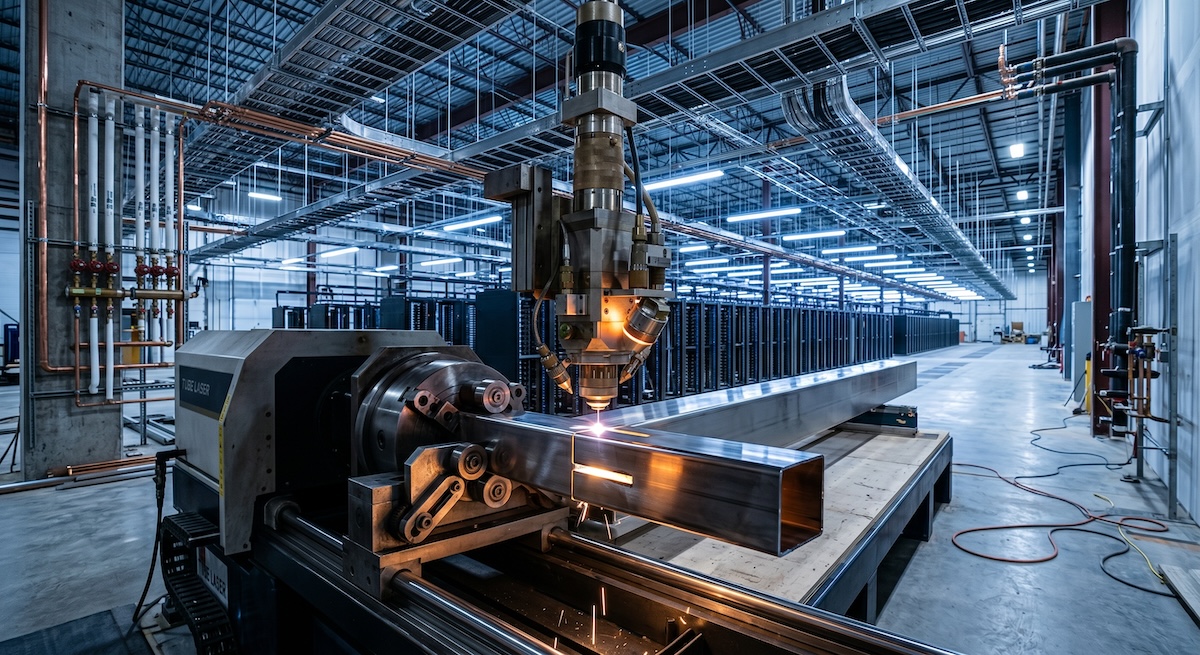
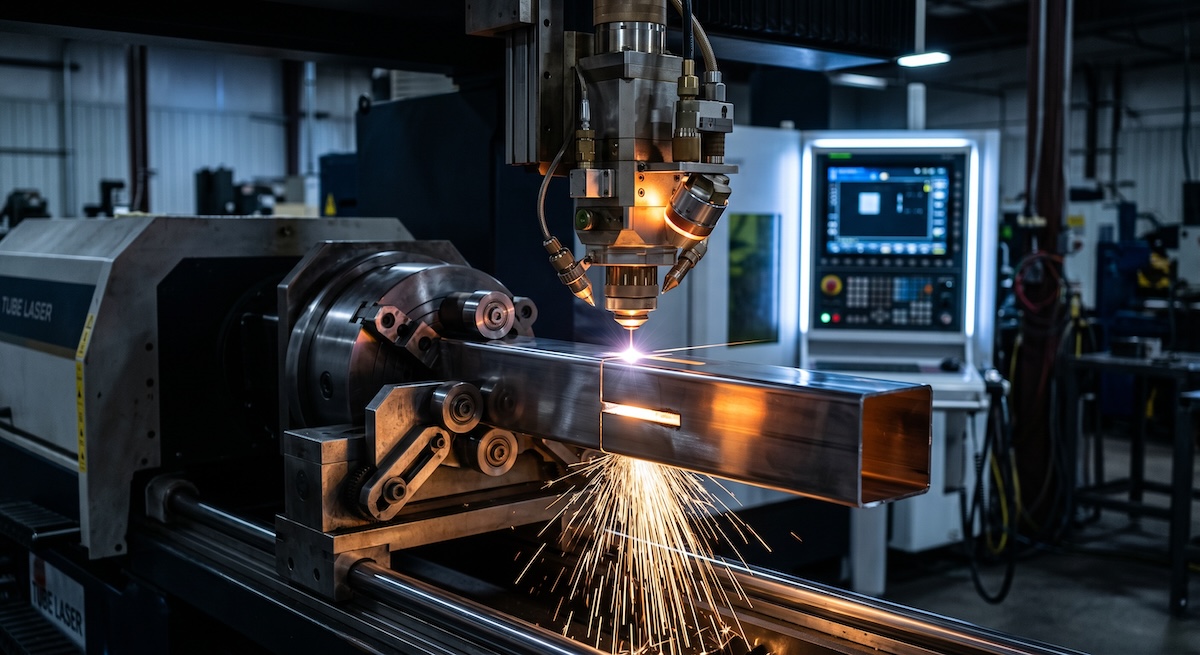
Quick Summary
- Tube laser nesting is the layout of your parts along full-length stock tube so the machine cuts as many as possible with as little leftover as possible.
- Waste shows up in two places: offcuts between parts and scrap at the end of each bar.
- Part lengths, quantities, and mixed part families all change how well a nest works.
- You can help yield by sending a full cut list with quantities and noting which parts can share a bar.

Tube laser nesting decides how your parts are arranged along a length of stock tube before the first cut. A good nest uses more of each bar and leaves less scrap, which lowers material waste on every job. A weak nest leaves short, unusable ends.
At Blueline Industries in Chino, CA, our tube laser cutting work starts from the cut list our customers send. This post explains how nesting works, what drives yield up or down, and what to put in your cut list so the layout works in your favor. It is written for engineers and buyers who want to understand where material goes, not for software specialists.
What Is Tube Laser Nesting?
Tube laser nesting is the process of planning how parts are placed along a stock tube so they can be cut with the least leftover material. Stock tube arrives in standard bar lengths. Software arranges your parts along each bar, then the laser cuts them in sequence.
Think of it like cutting trim from a long board. Every part needs a certain length. The nest decides which parts share a bar, in what order, and where the leftover ends up. The goal is to cut your quantity from as few bars as possible.
Nesting for tube differs from sheet nesting. Parts are laid out in one dimension, along the length of the bar, rather than across a flat plate. That makes length the main driver of yield.
Where Does Material Waste Come From in Tube Cutting?
Waste comes from two places: offcuts between parts and scrap at the end of each bar. Offcuts appear when part lengths do not add up neatly. End scrap appears because the last part on a bar rarely uses every inch that remains.
A tube laser manufacturer's guide on material usage describes the same split. Its simulator for testing bar lengths reports the waste divided between offcuts between parts and end-of-bar scrap. The same guide notes that the last bar often is not fully used, and that reusing that scrap takes handling effort and storage space.
Kerf, the thin slot the laser removes with each cut, also takes a small amount of length. Our post on kerf in tube laser cutting explains it in more detail.
What Factors Change How Well a Tube Nest Works?
Part length, quantity, the mix of part families, and the stock length available all change yield. Parts that divide evenly into the bar length nest well. Odd lengths and tiny quantities leave more scrap, because there are fewer combinations to fill each bar.
Part length versus bar length
If your part is just over half a bar, you get one part per bar and a long offcut. A small change in part length can let two parts share a bar. Ask whether the length has any flexibility before it is locked.
Quantity
Larger quantities give the layout more ways to fill each bar. A run of a few pieces has little room to optimize. That is normal, and it is one reason short runs carry more material overhead per part.
Mixed part families
When several part numbers cut from the same tube size and grade, the layout can combine them on shared bars. Sending related parts in one request, rather than one at a time, gives the shop more to work with.
Stock length
The same guide describes nesting approaches based on stock: bars of one fixed length, bars of mixed lengths matched to what is on hand, or a computed bar length that fits the job best. Which options apply depends on what material the shop can source or has in stock.
Can Parts Share a Cut to Save Material?
Sometimes. A common cut lets two adjacent parts share one cut between them, which removes waste at the joint. It only works when the facing ends of neighboring parts are compatible, such as straight or complementary ends, and when the shop's software and machine support it.
The guide describes a common cut option that cuts the facing ends of adjacent workpieces in one pass. Whether it applies to your parts depends on end geometry, and not every shop or machine uses it. If your design has straight cut ends, ask your fabricator whether shared cuts are possible.
Parts with angled or notched ends often cannot share a cut. That is fine. Function comes first, and part geometry should never be changed just to save a sliver of material.
How Do You Write a Cut List That Helps the Nest?
Send one complete cut list with tube shape, size, wall thickness, grade, part length, quantity, and end conditions for every part. Add notes on flexible lengths and whether parts may be combined across orders. The more complete the list, the better the layout.
Our post on how to spec a cut list for tube notching walks through what a clean list looks like. The same habits apply here.
Cut list detailWhy it helps the nestGrade and wall thickness on every lineShows which parts can share a barQuantity per partLets the layout fill bars instead of guessingLength tolerance or flexibilityMay allow two parts per bar instead of oneEnd conditions (square, angled, notched)Shows which parts might share a cutAll related part numbers in one requestGives the layout more combinations
What Does Nesting Mean for Short Runs and Prototypes?
Short runs and prototypes usually carry more scrap per part, because there are fewer parts to fill each bar. That cost is normal and is part of why prototype pricing differs from production pricing. Consolidating revisions and sizes into one request can reduce it.
Blueline handles custom tube prototyping and short run fabrication out of our Chino shop. If you plan to scale a design, tell us. Knowing the production volume up front helps us talk with you about material choices that nest well later.
Blueline does not publish prices or lead times in advance. Both depend on material, quantity, and schedule, and nesting is one input among several.
Frequently Asked Questions
What is nesting in tube laser cutting?
Nesting is the layout of parts along stock tube so the laser can cut them with minimal leftover material. Software arranges the parts, then the machine cuts them in sequence.
Does nesting change what my parts cost?
Material yield is one factor in cost. Other factors include material grade, part complexity, quantity, and setup. We do not quote prices without seeing your parts.
Can I reduce scrap by changing part length?
Sometimes. A small length change can let two parts share a bar. Only change length if the design allows it, and confirm with your engineer first.
Do all parts share bars?
Only parts of the same tube shape, size, wall thickness, and grade can share a bar. Different materials are cut from different stock.
What should I send to get the best layout?
A full cut list with every part, quantity, material spec, length, and end condition. Include flexible lengths and any related part numbers.
Send the Cut List, We Will Look at the Layout
Have a cut list ready, or want a second set of eyes on one before you send it? Our team in Chino, CA is happy to look it over. Get a Quote or call (951) 833-5597. See all of our tube laser cutting services.