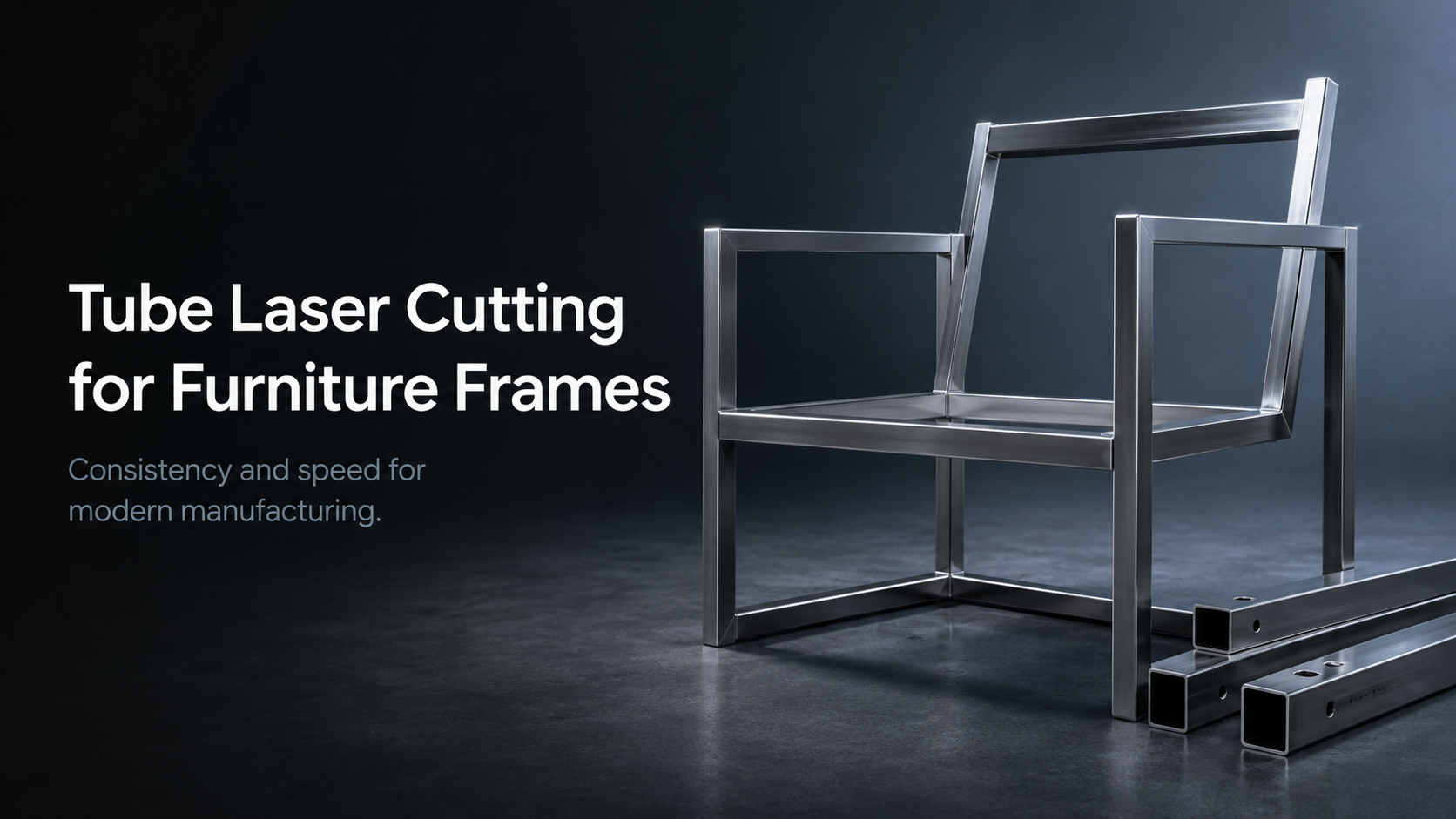
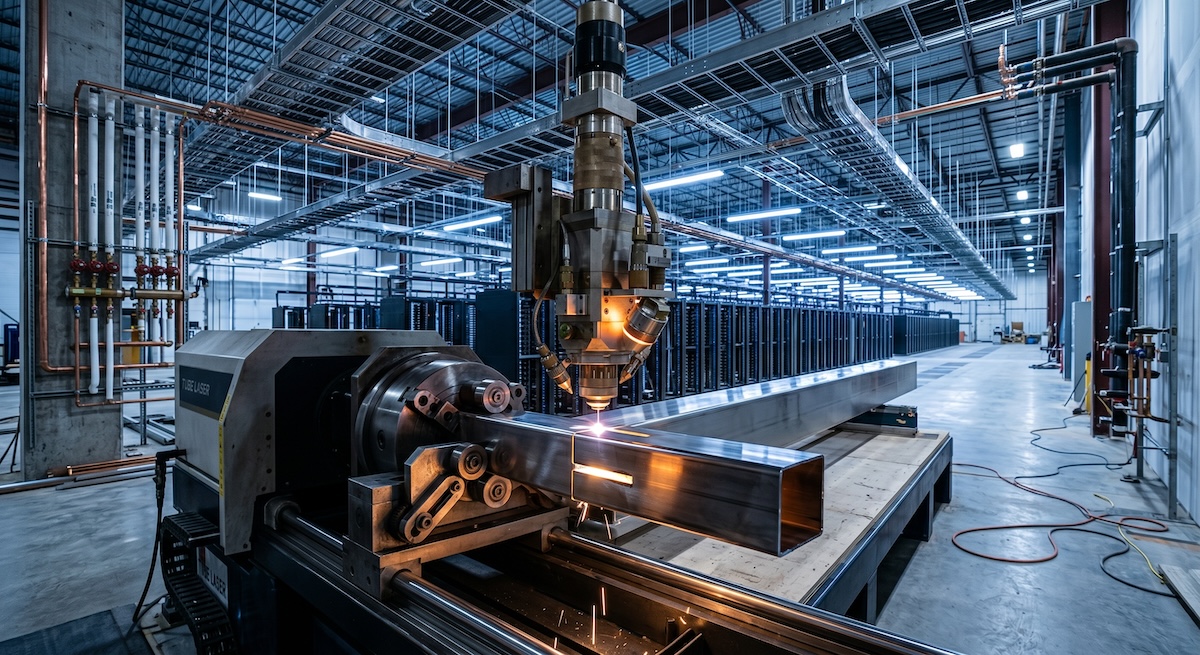
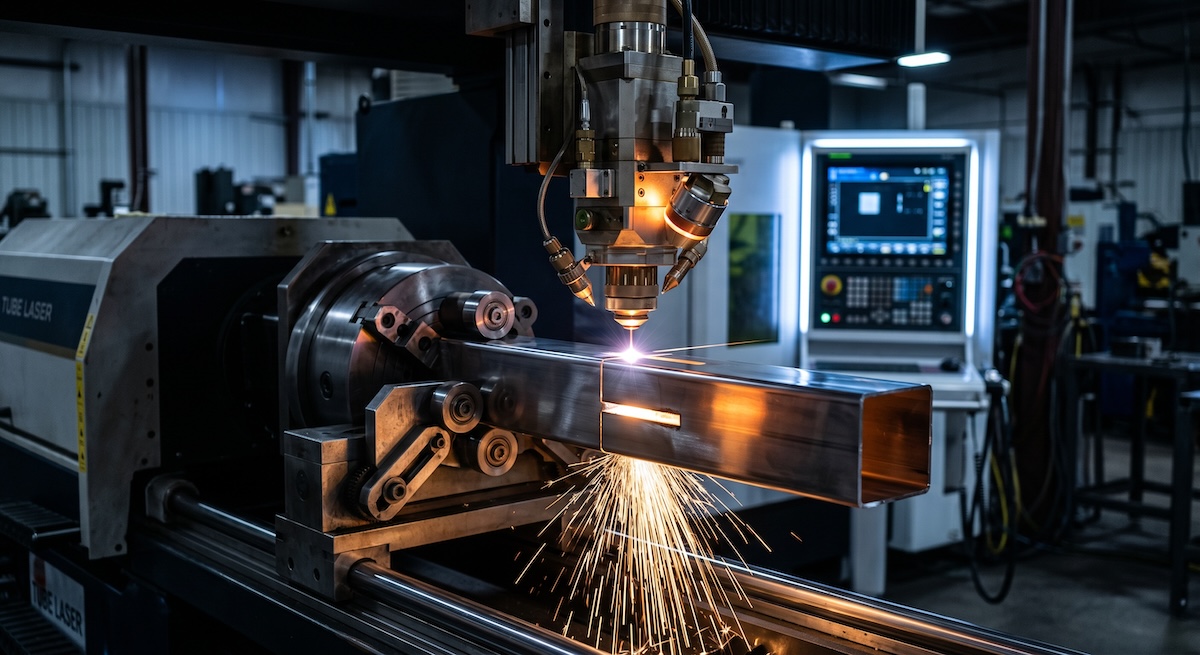
Quick Answer: The global data center piping market is projected to grow from $750 million in 2025 to over $7.4 billion by 2033, driven almost entirely by the explosion in liquid cooling infrastructure for AI facilities. Nitrogen cooling systems, which use stainless steel piping networks to circulate cryogenic or near-cryogenic nitrogen for heat rejection in high-density GPU clusters, demand fabrication tolerances and material handling capabilities that conventional metalworking shops cannot deliver at the volumes and timelines AI construction schedules require. Tube laser fabrication has emerged as the processing method of choice because it consolidates the multi-step workflow of sawing, drilling, notching, and tapping stainless steel tube stock into a single CNC-controlled operation, cutting fabrication lead times by 40 to 60% while maintaining the ±0.003-inch accuracy that leak-free cooling connections demand.
There is a reason data center cooling has shifted from a line item on a mechanical contractor's scope to a board-level strategic concern. The thermal loads inside AI-optimized facilities have outrun the physics of conventional cooling within a single hardware generation.
Traditional enterprise data centers operated at 5 to 8 kilowatts per rack, cooled by conditioned air pushed through raised floor plenums. Current AI facilities routinely exceed 50 kW per rack. Nvidia's Blackwell GB300 systems hit 163 kW. The upcoming Vera Rubin NVL144 is expected to push past 300 kW per rack. And Nvidia's latest compute tray designs eliminate fans entirely, committing fully to liquid-cooled architectures.
At these densities, air cooling is not insufficient. It is physically impossible. The thermal energy generated by a row of AI racks cannot be removed by moving air across heat sinks regardless of how much air you push. The industry has crossed a threshold where liquid-based thermal management is not an option; it is the only path to keeping processors from throttling or failing.
Within liquid cooling, nitrogen-based systems represent the high end of the performance spectrum. Used for heat rejection in the most demanding AI deployments, nitrogen cooling infrastructure involves stainless steel piping networks that must maintain precise tolerances under temperature extremes, resist corrosion over decades of continuous operation, and integrate seamlessly with rack-level distribution manifolds across hundreds of identical installations. The fabrication demands are intense. And the fabrication method that meets them is tube laser processing.
What Nitrogen Cooling Infrastructure Actually Looks Like
Nitrogen cooling in AI data centers is not a single component. It is a distributed piping system that spans the facility, connecting heat sources (GPU racks) to heat rejection equipment (cooling towers, heat exchangers, or dedicated nitrogen plants) through an extensive network of fabricated stainless steel tube components.
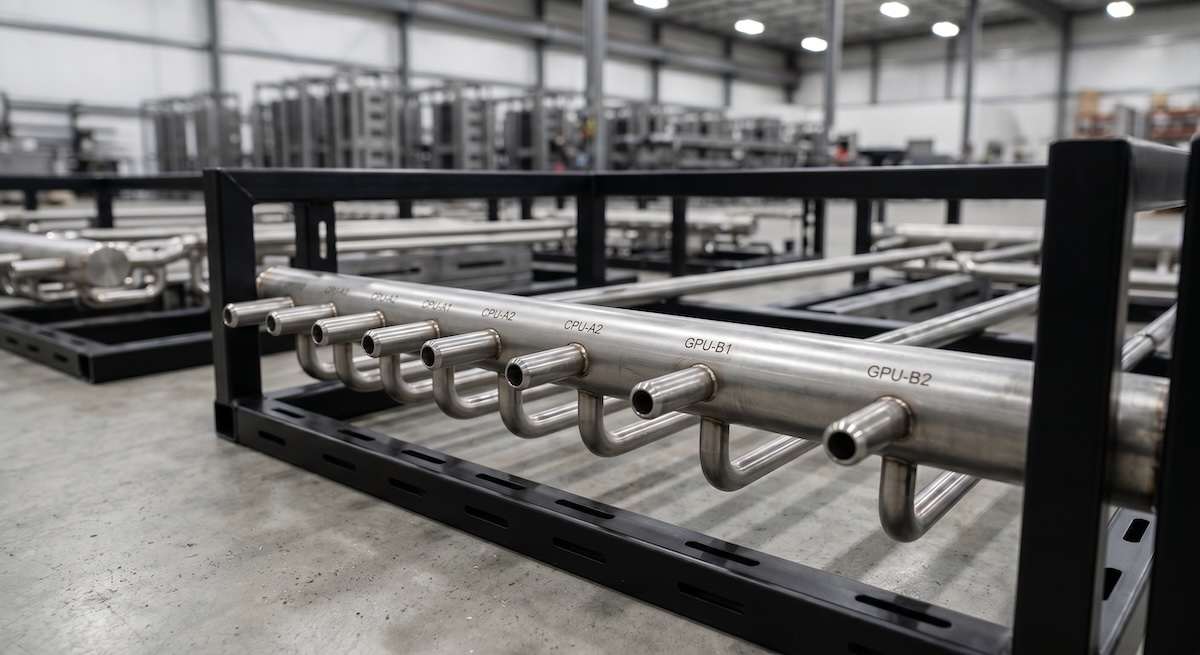
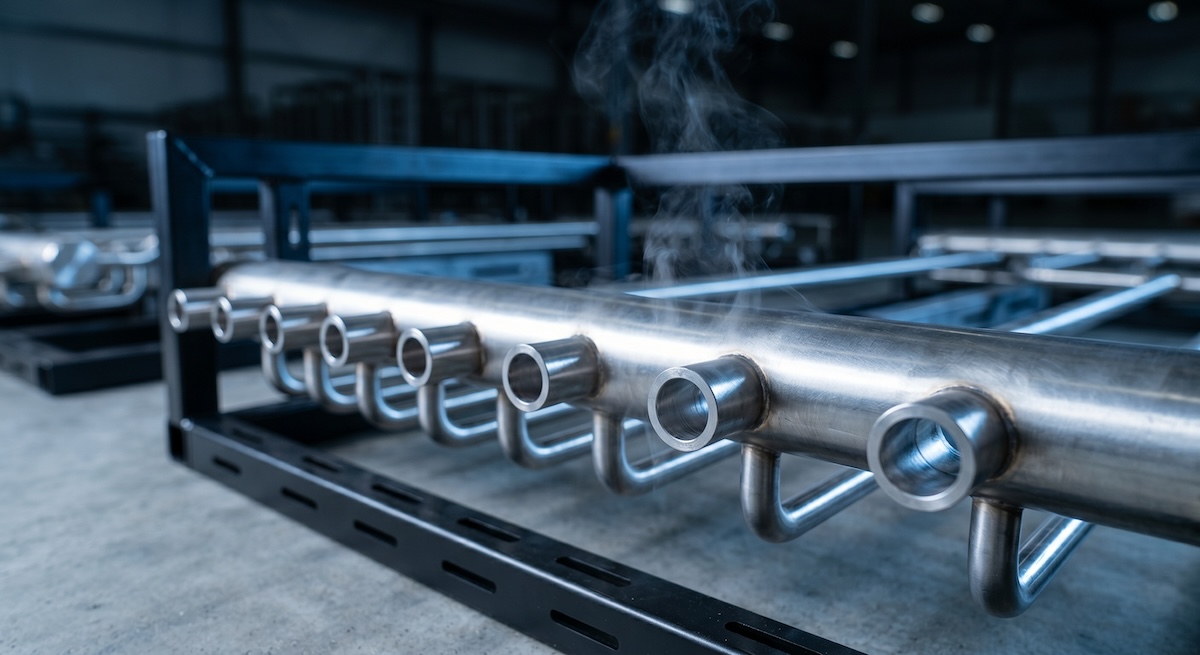
The system architecture typically includes facility-level distribution headers that carry nitrogen or nitrogen-cooled fluid between the cooling plant and individual data halls. These are large-diameter stainless steel tubes (often 4 to 12 inches) with precisely located branch connections, isolation valve provisions, and instrumentation ports. Row-level manifolds distribute coolant from the hall-level headers to individual rack rows. Each manifold requires branch connections spaced at exact intervals matching the rack layout, with connection geometries that allow tool-free maintenance access. Rack-level supply and return connections interface between the row manifold and the individual rack's cooling distribution unit (CDU). These connections require tight tolerances because any misalignment between the manifold and the rack creates stress on fittings that leads to leaks over time. Support and mounting infrastructure holds the entire piping network in position, accounts for thermal expansion across temperature cycles, and provides seismic restraint in regions like California where code requirements are stringent.
Every one of these component categories is fabricated from stainless steel tube stock, and every one requires multiple features per part: holes, slots, notches, saddle cuts for tube-to-tube intersections, mounting provisions, and identification marks. The total component count for the nitrogen cooling infrastructure in a single 50 MW AI data hall can reach 3,000 to 5,000 individual fabricated tube parts across 100 or more distinct part numbers.
Why Conventional Fabrication Fails at This Scale
The conventional approach to fabricating stainless steel cooling piping follows a workflow designed for an era when data centers needed hundreds of cooling components rather than thousands.
The process begins with saw cutting 304L or 316L stainless steel tube stock to length. Parts then move to a drill press where connection holes are located and drilled. Slots for adjustable mounting require a separate milling operation. Saddle cuts for tube-to-tube intersections need a hole saw or specialized coping machine. Tapping for threaded sensor ports adds another station. And between each operation, parts queue for machine availability, operators set up fixtures, and quality technicians verify dimensions.
This workflow breaks down under AI-scale cooling infrastructure demands for three interconnected reasons.
The tolerance problem is magnified. Every re-fixturing event between operations introduces positional drift. When a branch connection hole on a distribution header lands 0.015 inches off its intended position, the cumulative effect across a data hall with 200 rack connections means that some percentage of connections will not align with their mating components. In a nitrogen cooling system where leak integrity is essential (nitrogen leaks in enclosed spaces create oxygen displacement hazards), dimensional accuracy is not a quality preference. It is a safety requirement.
The timeline math does not work. Research estimates that a 60 MW data center loses approximately $14.2 million for every month of delay. The conventional multi-step fabrication process for a 3,000-component stainless steel cooling package consumes 8 to 12 weeks of shop time. AI data center construction timelines, already compressed by competitive pressure to bring capacity online, cannot absorb this duration without cascading impacts on mechanical installation, commissioning, and revenue generation.
Stainless steel amplifies every inefficiency. The 300-series austenitic stainless steels used in cooling applications are harder to drill, slower to tap, and more abrasive on tooling than carbon steel. Each conventional operation takes longer, tooling wears faster, and the risk of work-hardening the material during machining (which degrades corrosion resistance in the affected zone) adds a quality dimension that does not exist with carbon steel fabrication. Operators working with stainless steel must be more experienced and more careful, and those operators are in short supply.
How Tube Laser Processing Solves the Cooling Infrastructure Bottleneck
Tube laser fabrication addresses each of these failure modes by consolidating the entire multi-step workflow into one automated sequence.
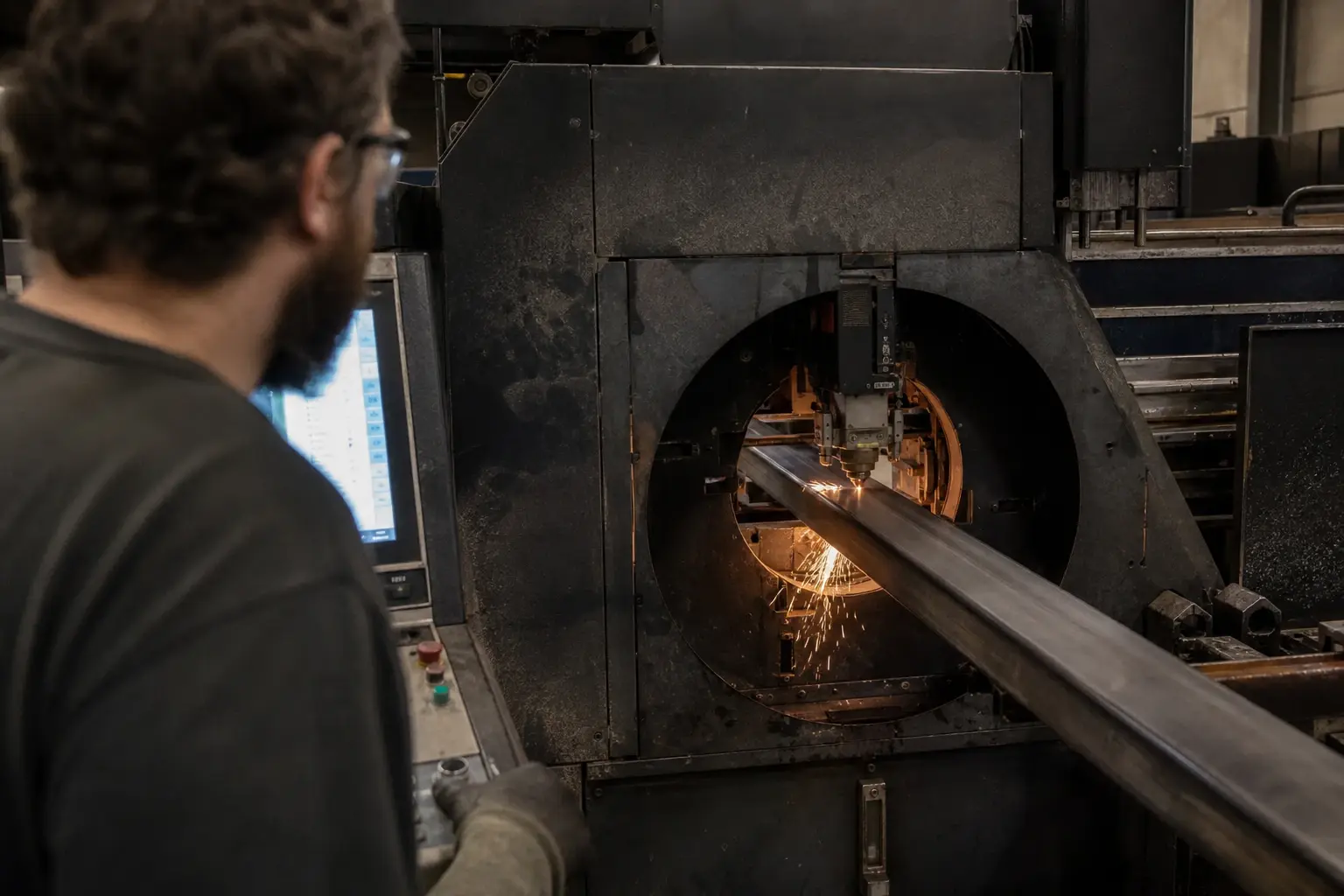
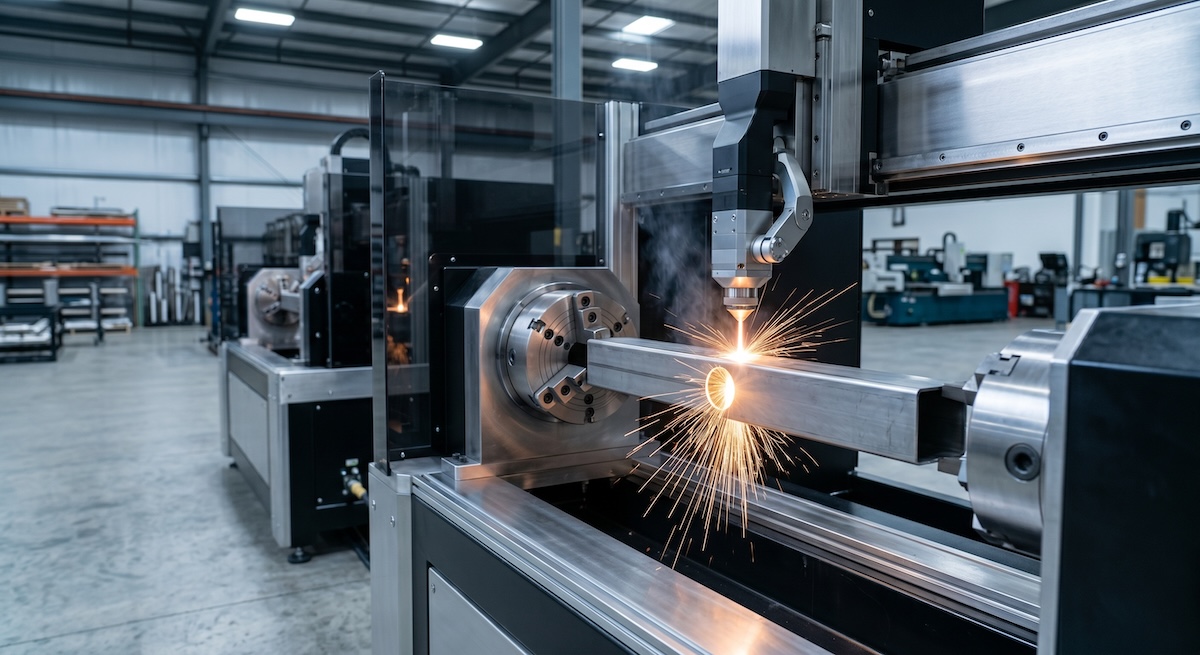
A fiber laser at 3 to 6 kilowatts, guided by a CNC program generated directly from 3D CAD models, cuts, drills, notches, slots, copes, and profiles stainless steel tube stock while the workpiece remains in a single multi-chuck fixture. The tube rotates and translates as the laser executes the complete feature set. A distribution header that would visit five conventional machines is completed in one cycle.
For nitrogen cooling infrastructure specifically, the advantages are both operational and technical.
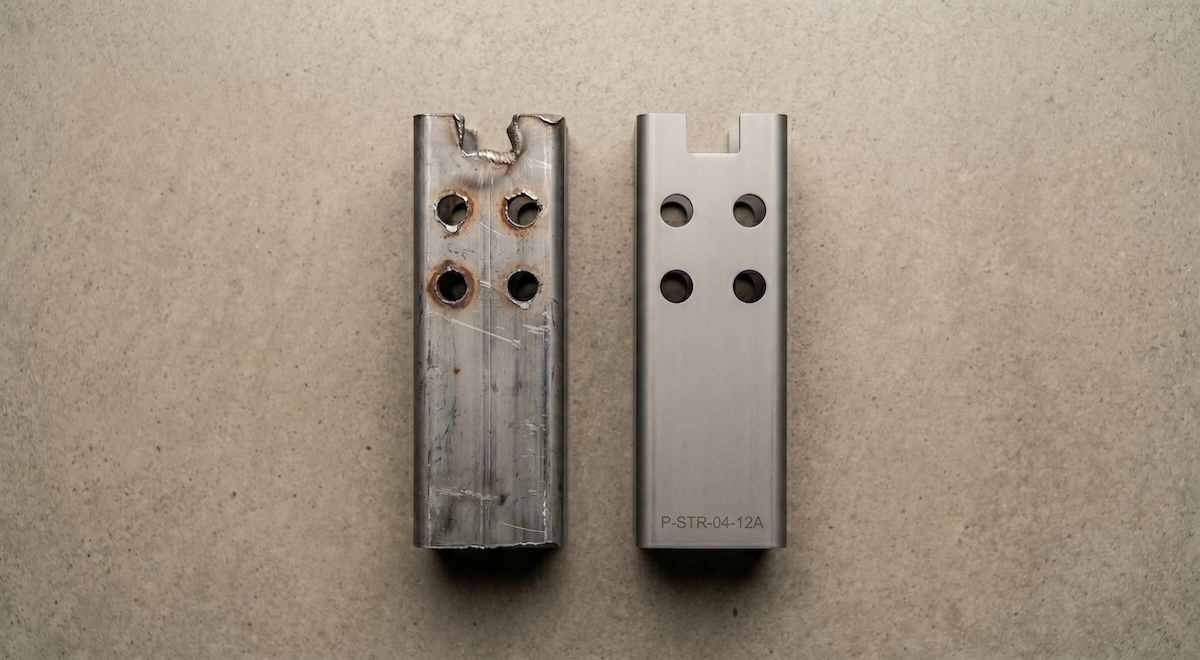
Dimensional accuracy meets safety requirements. Because the tube never leaves the machine between operations, every feature references the same datum. Positional accuracy of ±0.003 inches is achievable and repeatable across production runs of thousands of parts. For nitrogen cooling connections where leak integrity depends on precise alignment between mating components, this consistency provides the dimensional assurance that conventional fabrication cannot guarantee at volume.
The heat-affected zone is minimized. Fiber laser cutting produces a narrow kerf with controlled heat input, which is critical for stainless steel cooling components. Unlike conventional drilling, which generates significant localized heat that can alter the grain structure and degrade corrosion resistance, laser cutting preserves the material properties in the cut zone. For components that will be in continuous contact with coolant fluids for 15 to 20 years, this metallurgical advantage translates directly into system longevity.
Lead times compress by 40 to 60%. The fabrication phase for a 3,000-component stainless steel cooling package drops from 8 to 12 weeks (conventional) to 3 to 5 weeks (tube laser). The savings come from eliminating queue time between stations, reducing setup between part numbers from hours to minutes, and simplifying quality verification because dimensional accuracy is inherent to the CNC process.
Material efficiency improves. Tube laser nesting algorithms optimize material utilization, reducing scrap rates from the 12 to 15% typical of conventional multi-step processing to 5 to 8%. Across a project consuming tens of thousands of pounds of 316L stainless steel (currently priced at a premium over carbon steel), material savings compound significantly.
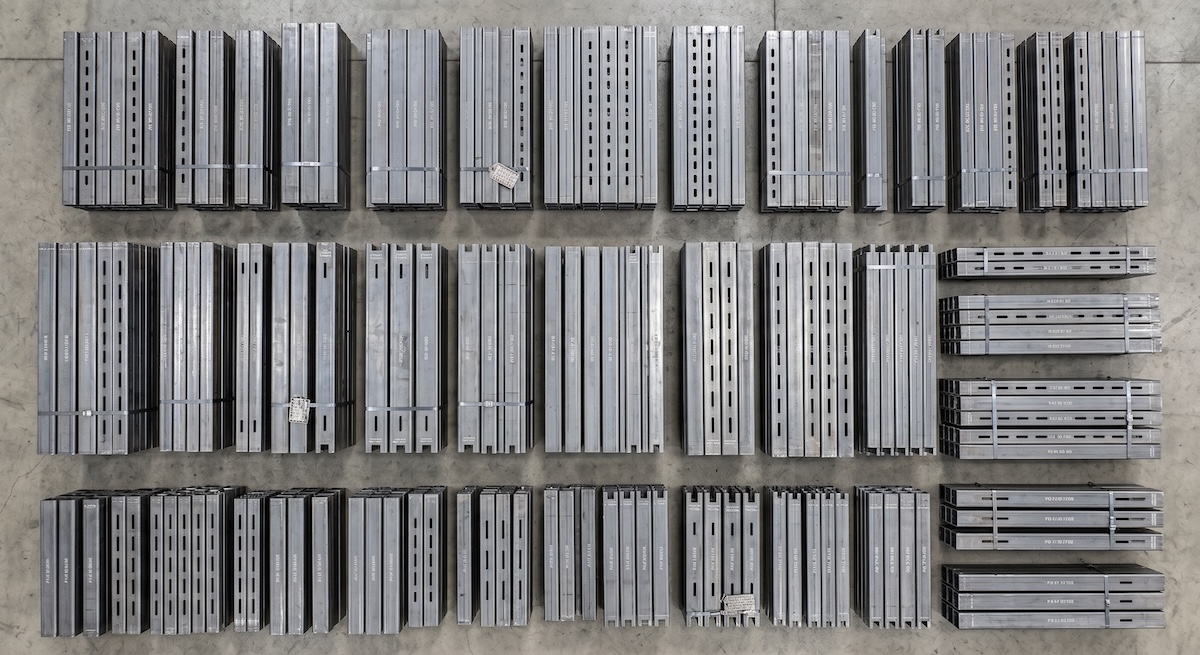
Part identification is permanent and automatic. The tube laser etches part numbers, assembly identifiers, and orientation marks directly into the stainless steel surface during the cutting operation. In a nitrogen cooling system where thousands of similar-looking tube components must be installed in precise locations, permanent identification eliminates the sorting labor that wastes installation crews' time on site.
The Volume Driving the Shift
The data center piping market is undergoing a structural expansion that explains why fabrication technology choices matter now more than they did even two years ago.
The global data center piping market reached approximately $750 million in 2025 and is projected to grow to over $7.4 billion by 2033, a compound annual growth rate of 33.2%. This growth is driven almost entirely by the shift from air-cooled to liquid-cooled architectures in AI data centers. The direct liquid cooling market specifically is expected to surpass $8 billion by 2030.
In practical terms, this means that the volume of stainless steel tube components flowing through fabrication shops for data center cooling applications is multiplying by an order of magnitude within the current decade. Fabrication capacity that was adequate when cooling piping represented a minor scope item on a data center project is now insufficient when cooling infrastructure rivals the electrical scope in complexity and component count.
This volume pressure is why leading data center builders are not simply asking existing fabrication partners to process more parts. They are seeking partners with the technology to process parts differently. Tube laser fabrication is the technology that makes the volume achievable within the timelines these projects demand.
What This Looks Like in Practice
Blueline Industries in Riverside, California provides a concrete example of how tube laser fabrication serves AI data center cooling infrastructure at scale. The company has processed large-volume stainless steel packages for data center cooling applications, including projects where 16 truckloads of stainless steel were received from East Coast suppliers, processed through tube laser machines, and shipped to project sites with every component etched, bundled by part number, and organized for installation sequence.
This is not small-batch custom work. It is production-scale fabrication of precision stainless steel cooling components at volumes measured in hundreds of thousands of pounds. The tube laser machines process the full range of stainless steel profiles (round, square, rectangular) and handle the wall thicknesses common in cooling applications (0.065 to 0.250 inches), adjusting power, speed, and nitrogen assist gas parameters through the CNC program without mechanical changeover between material types.
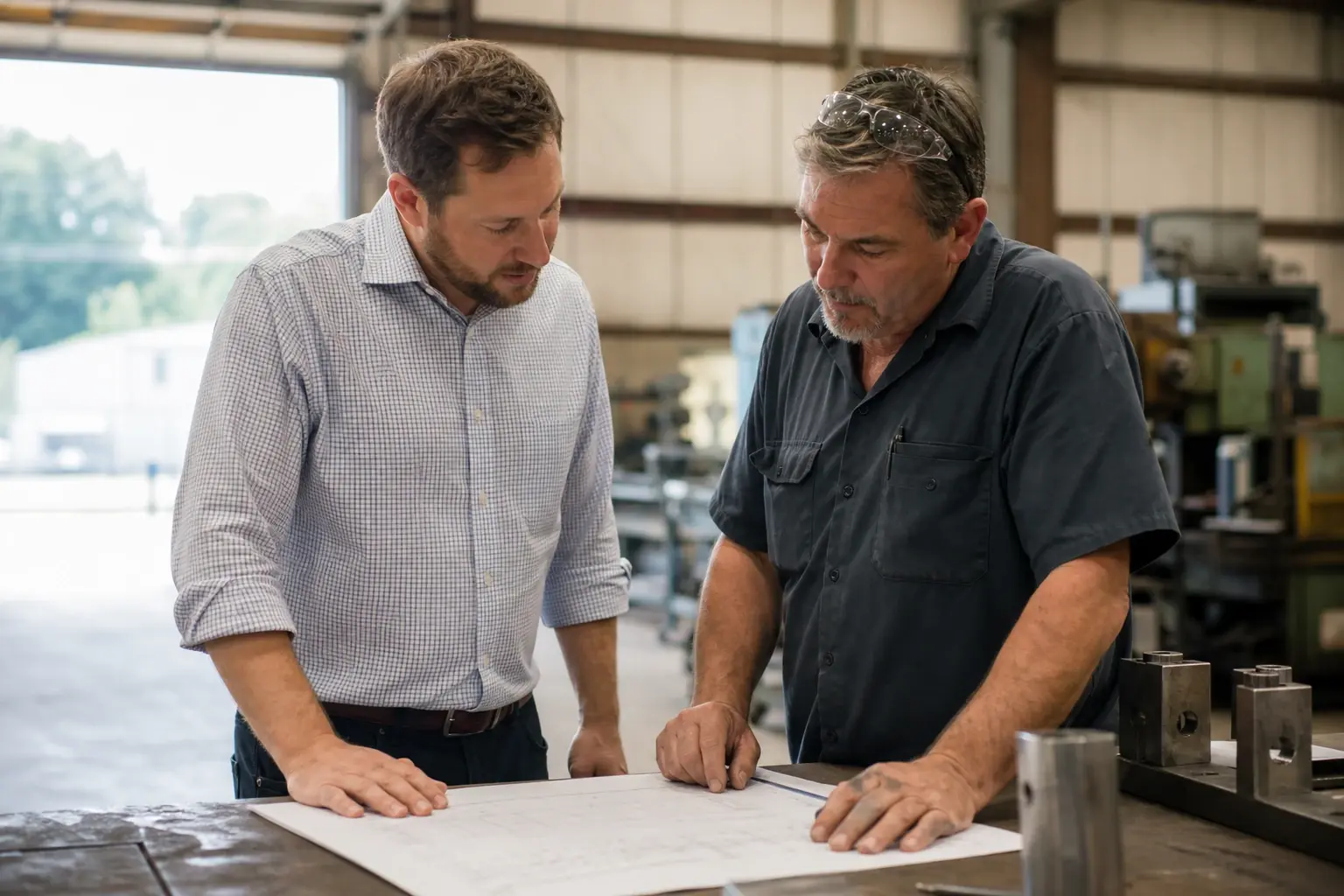
The engineering capability to translate architectural drawings or schematic cooling layouts into production-ready shop drawings is equally important. AI data center cooling designs evolve during construction as rack configurations are finalized, equipment specifications change, and thermal modeling refines the distribution layout. A fabrication partner with in-house engineering can absorb these changes and update CNC programs without the delays inherent in external detailing workflows.
Why Stainless Steel Remains the Material of Choice
Despite emerging alternatives like high-performance polymers, stainless steel continues to dominate nitrogen cooling infrastructure for reasons grounded in the application requirements.
Nitrogen cooling systems operate across temperature ranges that stress material joints and seals. The 300-series austenitic stainless steels (304L and 316L) maintain structural integrity and ductility at cryogenic and near-cryogenic temperatures where many alternative materials become brittle. The 316L grade offers superior resistance to pitting and crevice corrosion when coolant fluids contain chlorides, which is relevant for facilities in coastal or high-humidity environments.
Stainless steel piping can be fabricated, installed, and modified using established techniques that mechanical contractors understand. The workforce that installs stainless steel piping in data centers draws from the same skill base that serves pharmaceutical, food processing, and semiconductor manufacturing. As the industry scales, this established fabrication and installation knowledge base reduces execution risk.
And importantly, stainless steel tube components fabricated by tube laser retain full material properties in the cut zone, which is not universally true for all cutting methods. The precision and low heat input of fiber laser cutting means that the corrosion resistance, mechanical strength, and surface finish of the parent material are preserved through the fabrication process.
Evaluating Fabrication Partners for Cooling Infrastructure
Data center builders evaluating fabrication partners for nitrogen cooling infrastructure should focus on several specific qualifications.
Stainless steel tube laser capability is non-negotiable. The partner must operate tube laser machines capable of processing 304L and 316L stainless steel across the profile range and wall thickness range relevant to your cooling design. Confirm that the machines can handle round, square, and rectangular profiles, and that the shop has experience optimizing laser parameters specifically for austenitic stainless steels.
Machine redundancy protects your schedule. A single tube laser is a single point of failure for your delivery timeline. Partners operating multiple machines can maintain production during maintenance, allocate capacity to urgent design changes, and absorb the volume surges common on fast-track AI data center projects.
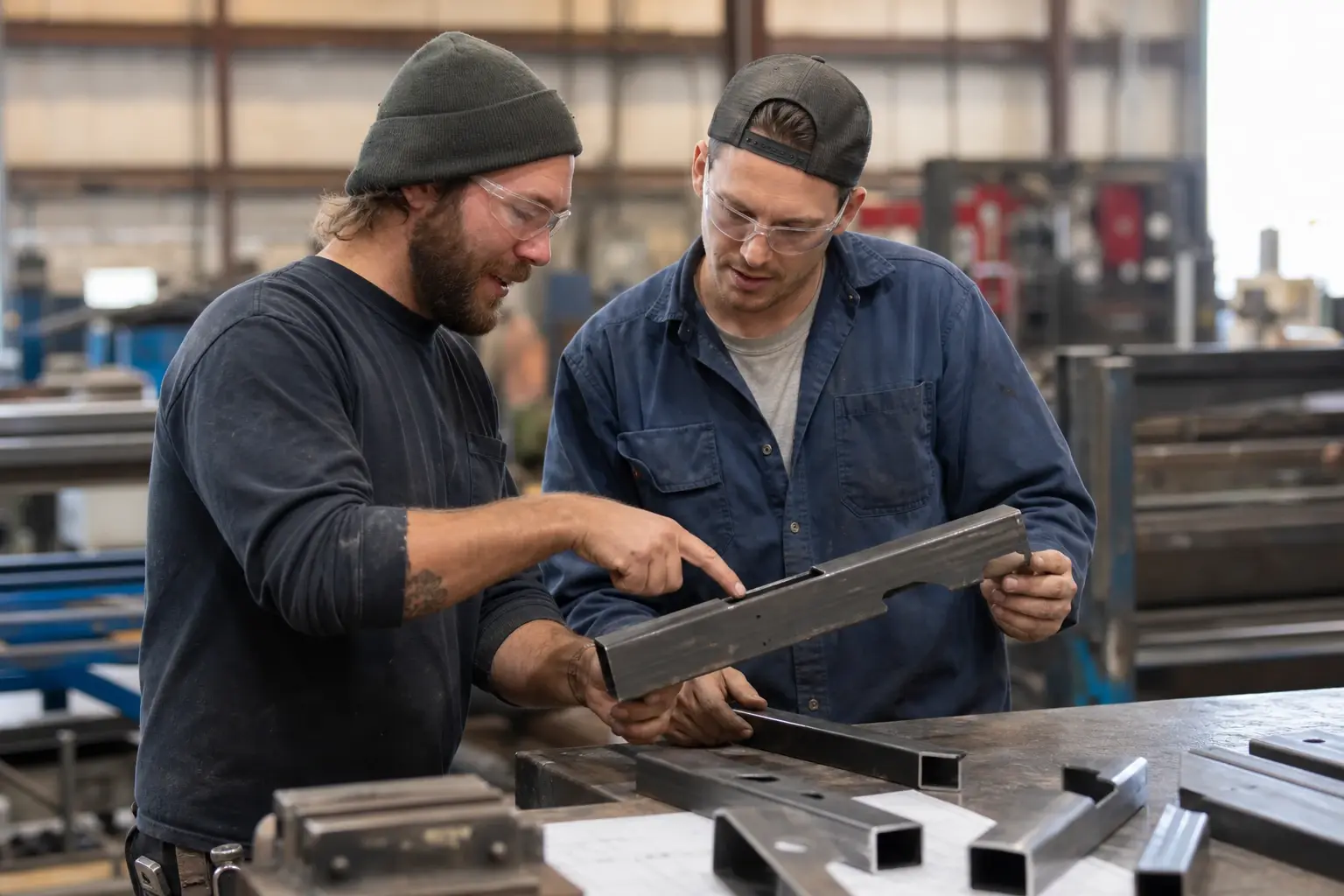
Engineering support accelerates the design-to-fabrication pipeline. The ability to convert cooling schematics into shop drawings, identify cut-and-fold opportunities that eliminate welding, and provide DFM feedback on connection designs adds weeks of value to the project timeline.
Volume experience matters. Processing a few hundred stainless steel components for a pilot installation is different from processing thousands for a production data hall. Ask for references from projects involving 1,000+ stainless steel tube components, and verify that the fabricator maintained dimensional consistency and delivery reliability across the full production run.
Part identification and logistics integration reduce field costs. Laser-etched identification, assembly-sequenced bundling, and delivery coordination aligned with your installation schedule turn the fabrication partner from a component supplier into a logistics asset.
Frequently Asked Questions
Why is nitrogen used for cooling in AI data centers instead of simpler coolants like water?
Nitrogen-based cooling systems offer several advantages for the highest-density AI deployments. Nitrogen provides superior heat absorption characteristics compared to air-based systems, and nitrogen cooling infrastructure can handle the extreme thermal loads generated by GPU clusters operating at 100+ kW per rack. In two-phase cooling configurations, nitrogen can transition between liquid and gas states to maximize heat transfer efficiency. Nitrogen is also non-conductive and non-corrosive, reducing the risk of equipment damage from coolant leaks. For facilities processing the most demanding AI training and inference workloads, nitrogen cooling provides thermal management performance that water-based systems alone cannot match at equivalent energy efficiency.
How does tube laser fabrication improve the leak integrity of nitrogen cooling piping?
Leak integrity in cooling piping depends on the dimensional accuracy of connection points where tubes mate with fittings, manifolds, and rack-level equipment. Conventional multi-step fabrication introduces cumulative positional drift through repeated re-fixturing, which can push connection features 0.015 to 0.025 inches off their intended positions. Tube laser fabrication maintains ±0.003-inch accuracy because the tube remains in a single fixture throughout the entire cutting sequence. This fivefold to eightfold improvement in positional accuracy means that connections align consistently across hundreds of identical installations, reducing the stress on seals and fittings that causes leaks over time. Additionally, the fiber laser produces clean cut edges without the burrs and material deformation that conventional drilling generates, which improves the seating surface quality at every connection point.
What makes stainless steel fabrication for cooling infrastructure different from general structural steel work?
Three factors distinguish cooling infrastructure fabrication. First, the material itself: 300-series austenitic stainless steels are harder to machine than carbon steel, more sensitive to heat input (which can degrade corrosion resistance), and more expensive (making scrap and rework more costly). Second, the tolerance requirements: cooling piping connections must seal against leaks under pressure and temperature cycling, demanding tighter dimensional control than typical structural work. Third, the surface quality: coolant-contact surfaces must be free of heavy dross, oxidation, and contamination that could degrade system performance over time. Tube laser fabrication with nitrogen assist gas produces clean edges on stainless steel that meet these requirements without secondary finishing operations, which is why it has become the preferred processing method for cooling infrastructure.
How large is the fabrication scope for nitrogen cooling in a typical AI data center?
The scope varies with facility size, but a representative 50 MW AI data hall might require 3,000 to 5,000 individual stainless steel tube components across 100+ distinct part numbers. These include facility-level distribution headers, row-level manifolds, rack-level connections, mounting brackets, support frameworks, and instrumentation provisions. Total stainless steel weight for the cooling piping package alone can exceed 100,000 pounds on a large facility. This volume represents a fabrication scope comparable to or exceeding the structural steel package, which is why fabrication capacity and lead time have become critical path items for AI data center construction.
How early should data center builders engage a tube laser fabrication partner for cooling infrastructure?
Engagement should begin during the design development phase, well before cooling piping drawings are finalized. Early involvement allows the fabrication partner to provide design-for-manufacturability feedback that can simplify fabrication and reduce cost (such as converting welded manifold assemblies into cut-and-fold single-piece components), establish material procurement timelines for the volume of stainless steel tube stock required, reserve machine capacity aligned with the project's construction schedule, and begin CNC programming in parallel with drawing finalization. Given the current demand pressure on tube laser fabrication capacity for data center work, builders who wait until drawings are complete to engage a fabrication partner risk finding that preferred shops are already committed to other projects.
Blueline Industries operates multiple tube laser systems from its Riverside, California facility, specializing in high-volume stainless steel tube fabrication for AI data center cooling infrastructure, nitrogen cooling piping systems, and industrial applications. The company has processed hundreds of thousands of pounds of stainless steel for data center projects, delivering precision components with laser-etched identification and assembly-sequenced packaging. For cooling infrastructure fabrication quotes, visit bluelineind.com or call (951) 833-5597.


.png)