Quick Answer: Traditional stainless steel fabrication for data center cooling infrastructure requires four to six separate operations (sawing, drilling, notching, deburring, tapping, welding), each with its own setup, queue time, and quality inspection. Tube laser technology consolidates these into a single CNC-controlled process, cutting total fabrication lead times from 8 to 12 weeks down to 3 to 5 weeks while improving dimensional accuracy to ±0.003 inches. For data center operators racing to bring AI and hyperscale facilities online, those recovered weeks translate directly into earlier revenue generation and faster capacity deployment.
The global data center construction pipeline has never been larger. McKinsey estimates that the United States alone will need roughly 35 gigawatts of new data center capacity by 2030, representing hundreds of billions in construction spending. Behind the headlines about AI chips and power contracts, there is a less visible bottleneck that delays project timelines again and again: the precision stainless steel components that make cooling systems, cable management, and structural frameworks actually function.
Stainless steel fabrication for data centers is not a commodity service. The cooling loops for liquid and nitrogen systems demand tight tolerances on complex tube geometries. The structural supports need to handle seismic loads while fitting into increasingly dense rack configurations. And the timelines are brutal. When a hyperscaler commits to a facility opening date, every week of fabrication delay cascades through electrical, mechanical, and commissioning schedules.
This is where single-process tube laser cutting has begun reshaping how data center components get built.
Why Data Centers Depend on Stainless Steel
Stainless steel is the material of choice for critical data center infrastructure for reasons that go beyond corrosion resistance. In high-density computing environments where a single rack can draw 40 to 100 kilowatts, thermal management is the engineering constraint that determines facility density, uptime, and operating cost.
The 300-series austenitic stainless steels (particularly 304 and 316L) offer a combination of properties that carbon steel and aluminum cannot match in these applications. They resist the galvanic corrosion that occurs when dissimilar metals meet coolant fluids. They maintain structural integrity across the temperature swings common in liquid cooling loops. And they meet the cleanliness standards required for facilities where particulate contamination can damage sensitive equipment.
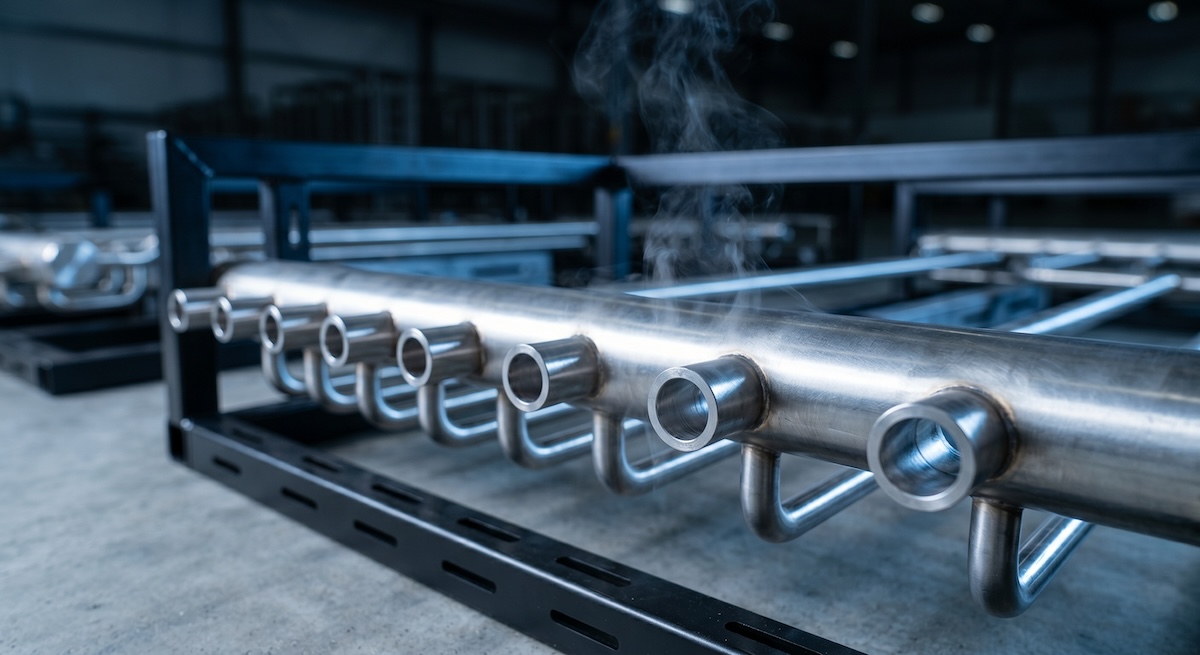
Data center stainless steel components generally fall into several categories. Cooling distribution manifolds and headers carry chilled water or dielectric fluid to individual racks. Structural tube frames support overhead cable trays and busway systems. Containment frameworks create hot-aisle and cold-aisle separations. And in newer AI-focused facilities, nitrogen and refrigerant piping systems require stainless steel tubing with precisely cut connection points, branch fittings, and mounting features.
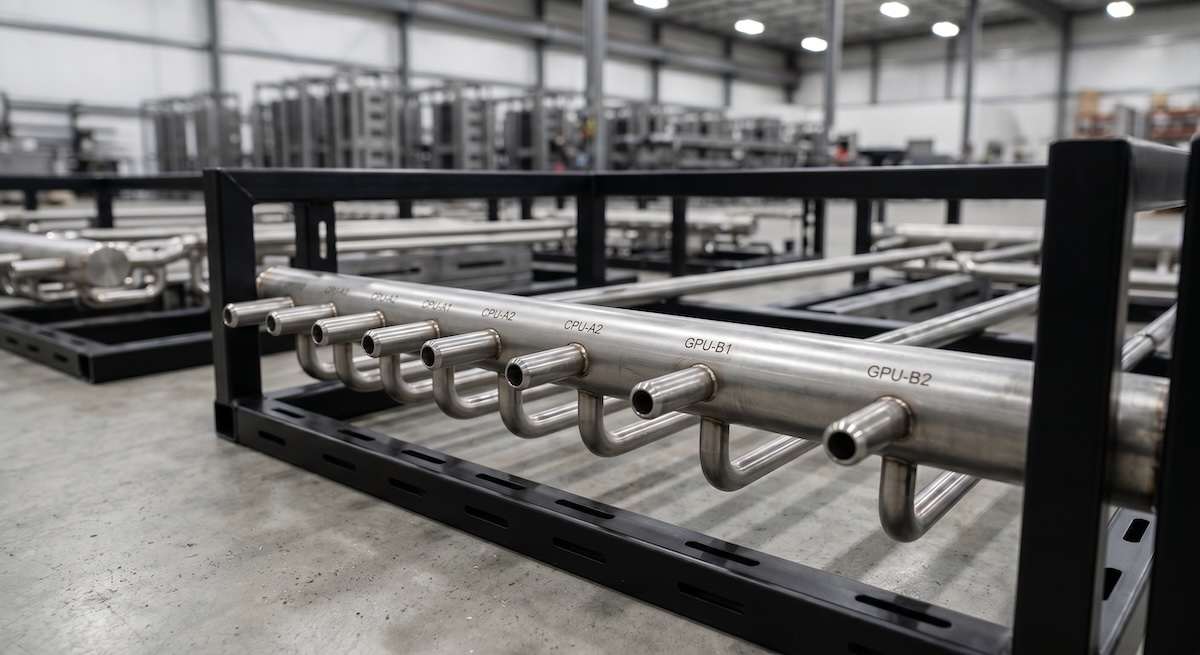
The common thread across all of these components is geometric complexity. A cooling manifold header is not just a tube cut to length. It requires precisely located branch connection holes, mounting slots, sensor ports, and alignment features, all held to tolerances that allow field assembly without rework.
The Traditional Fabrication Bottleneck
To understand why single-process cutting matters, it helps to trace how stainless steel data center components were fabricated before tube laser technology became accessible.
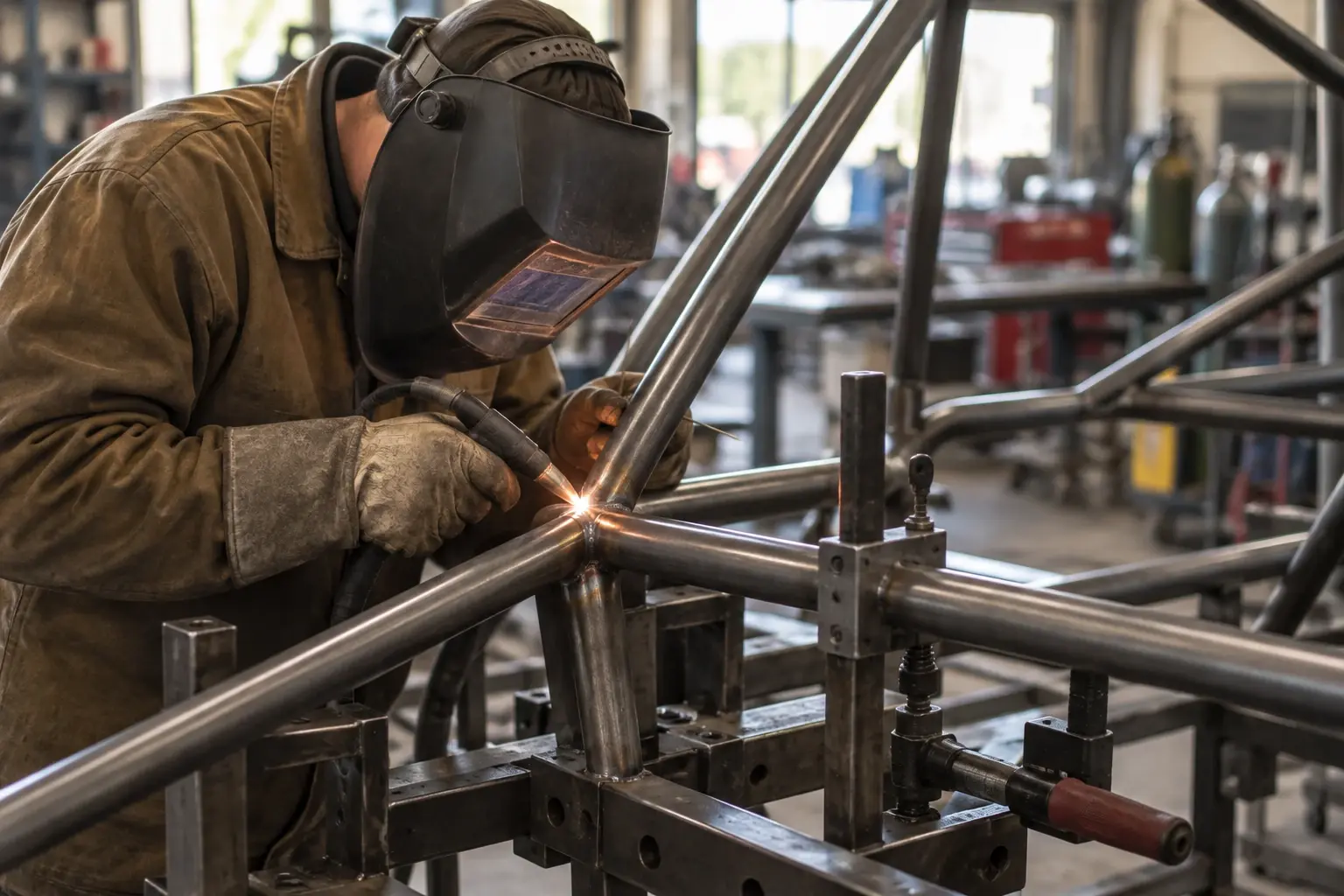
The conventional workflow starts with saw cutting raw tube stock to length. That operation alone requires setup, fixturing, and measurement for each unique part number. The cut tubes then move to a drilling station where connection holes are located, center-punched, and drilled. If the design calls for slots (common for adjustable mounting), those require a separate milling operation. Notching for tube-to-tube joints adds another station. Tapping threaded holes adds yet another. And between each operation, parts sit in queue waiting for machine availability.
Each of these transfers introduces three problems that compound across a data center project involving thousands of unique part numbers.
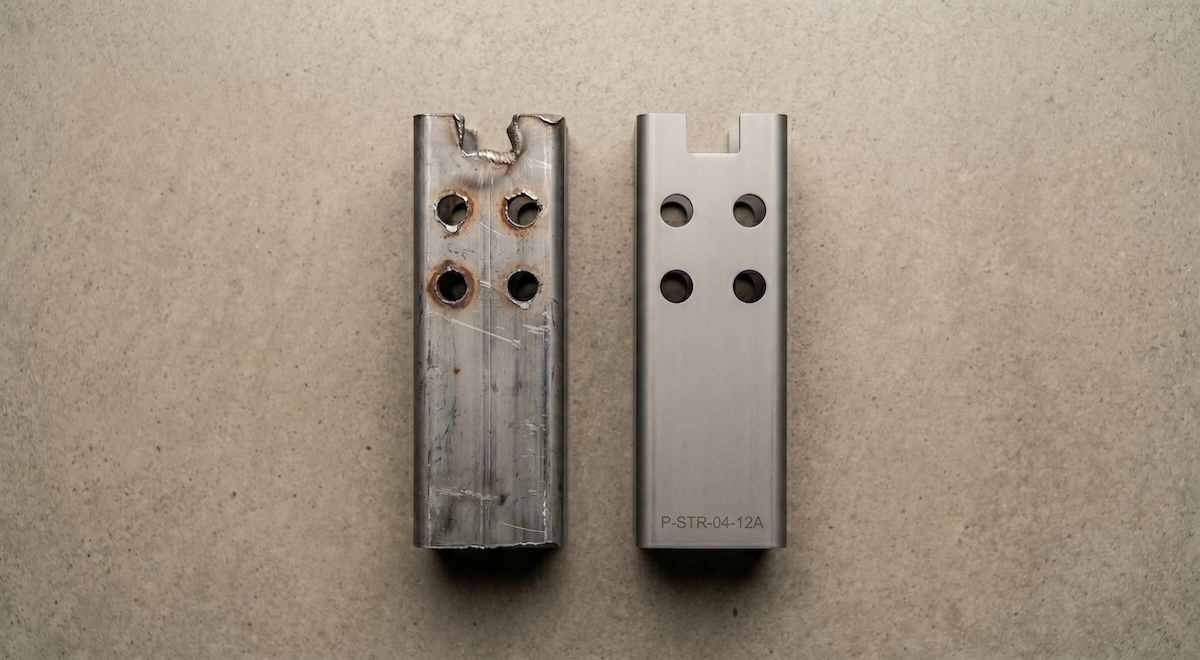
First, there is cumulative tolerance stack. Every time a part is removed from one fixture and clamped into another, positional accuracy degrades. A hole that was supposed to be 3.250 inches from the tube end might land at 3.262 inches after the part shifted slightly during re-fixturing. Multiply that drift across dozens of features per part, and field assembly becomes an exercise in forcing components together or shimming gaps.
Second, there is throughput math. If each operation takes 15 minutes of active machining but 2 hours of queue and setup time, a part with five operations accumulates 10+ hours of non-cutting time. Across a project with 2,000 unique parts, those queue hours add up to weeks of calendar time.
Third, there is the skilled labor dependency. Each traditional operation requires an experienced operator who can read drawings, set up fixtures, and verify dimensions. The American Welding Society and Fabricators & Manufacturers International have documented the growing shortage of skilled metalworkers. When a key operator calls in sick or leaves for a higher-paying job, production stops.
For data center construction project managers, these compounding delays are not abstract concerns. A two-week fabrication slip pushes back mechanical rough-in, which delays electrical termination, which pushes commissioning, which postpones the revenue-generating date for the entire facility.
How Single-Process Tube Laser Cutting Works
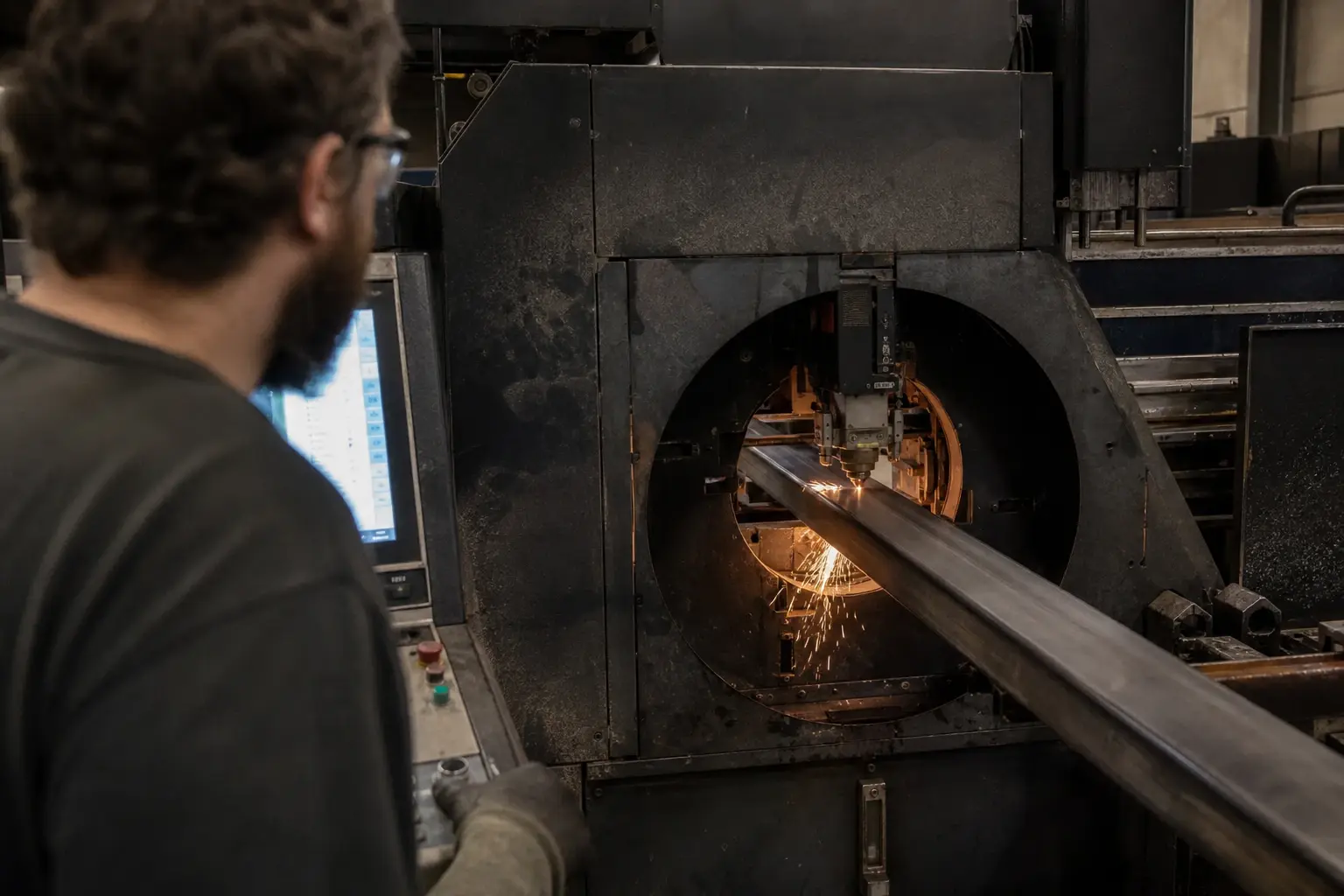
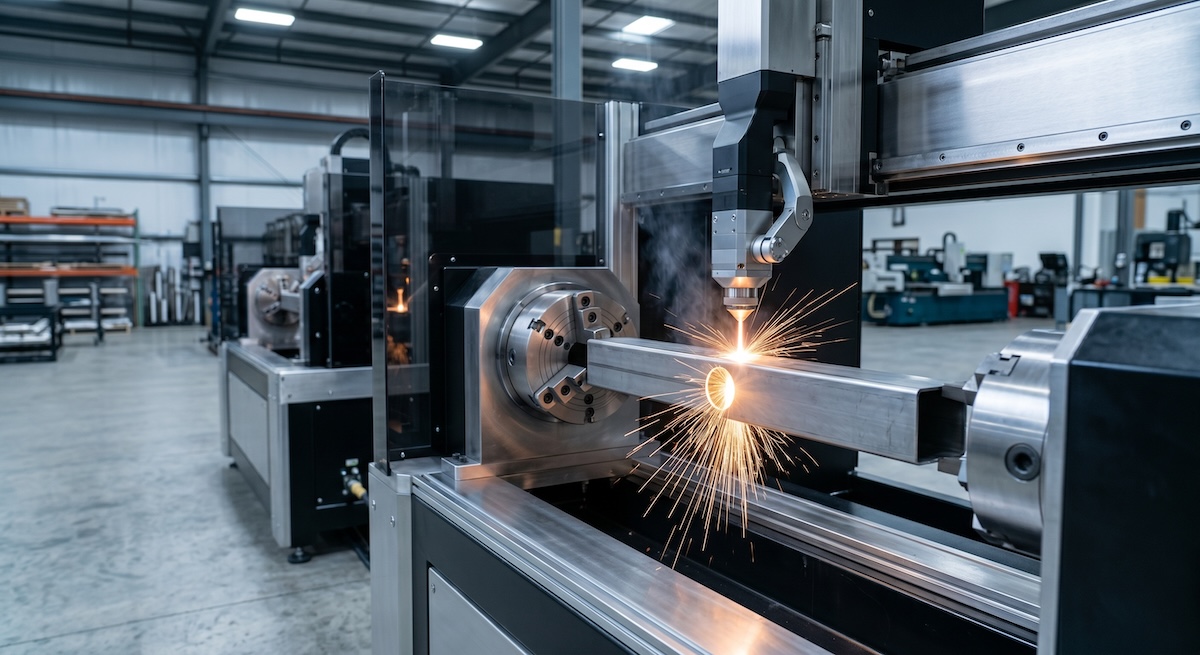
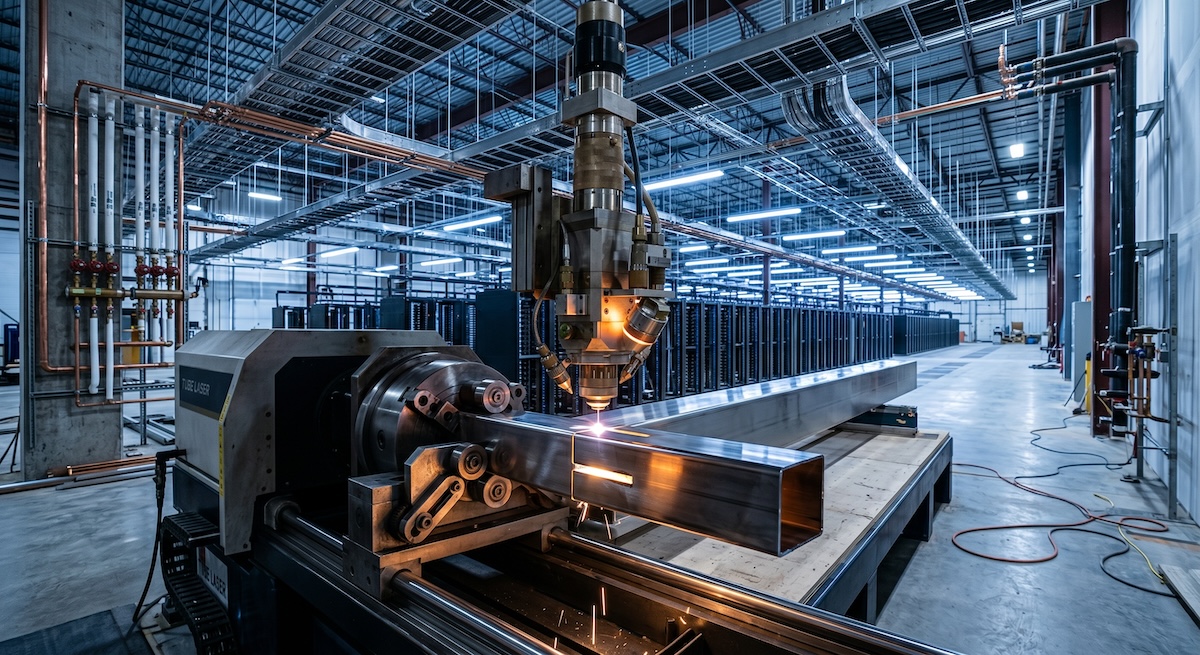
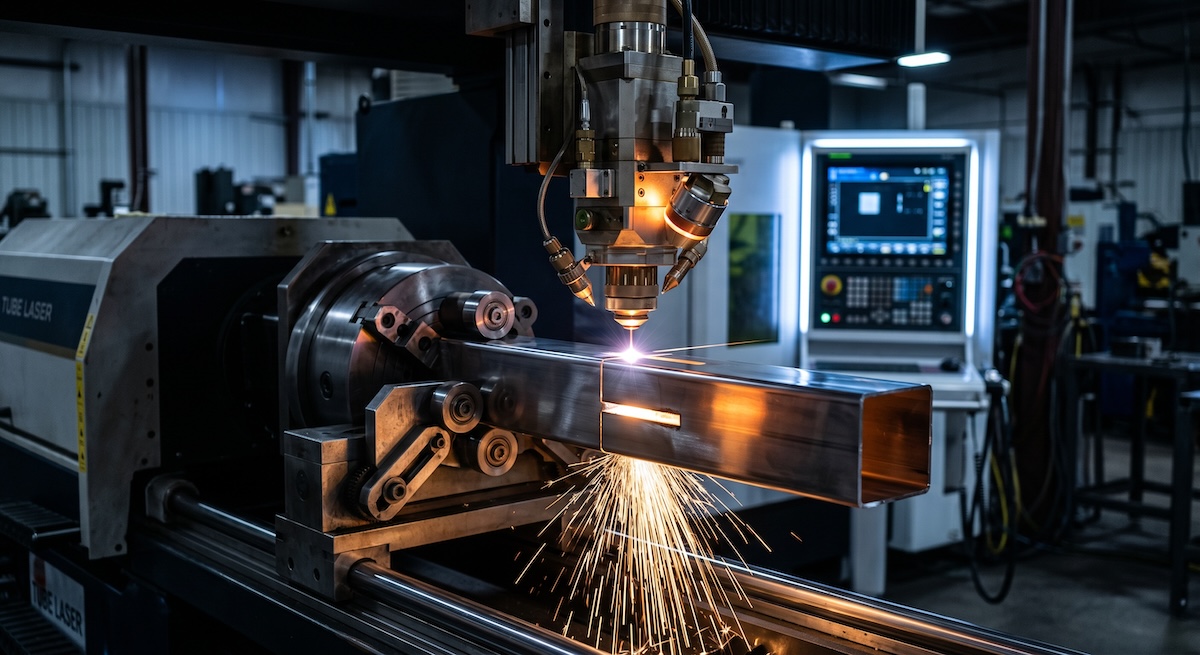
Tube laser cutting addresses fabrication bottlenecks by consolidating multiple operations into one automated sequence. The technology uses a fiber laser (typically 3 to 6 kilowatts for stainless steel tube work) guided by CNC programming to cut, drill, notch, slot, and profile tubular material in a single fixturing.
Here is what the process looks like in practice. A length of stainless steel tube stock is loaded into the machine's chuck system. The CNC program, generated directly from 3D CAD models or shop drawings, controls the laser head through the complete sequence of features. The tube rotates and translates while the laser cuts. A part that would require five separate operations on conventional equipment is completed in a single cycle with no re-fixturing, no queue time between stations, and no cumulative tolerance degradation.
Modern tube laser systems like the machines operated at Blueline Industries in Riverside, California can process round, square, and rectangular stainless steel profiles. The three-chuck clamping systems maintain part rigidity throughout the cutting sequence, which is critical for the thin-wall tubing common in cooling applications. Five-axis cutting heads handle complex bevel cuts and angled features that would be extremely difficult to produce conventionally.
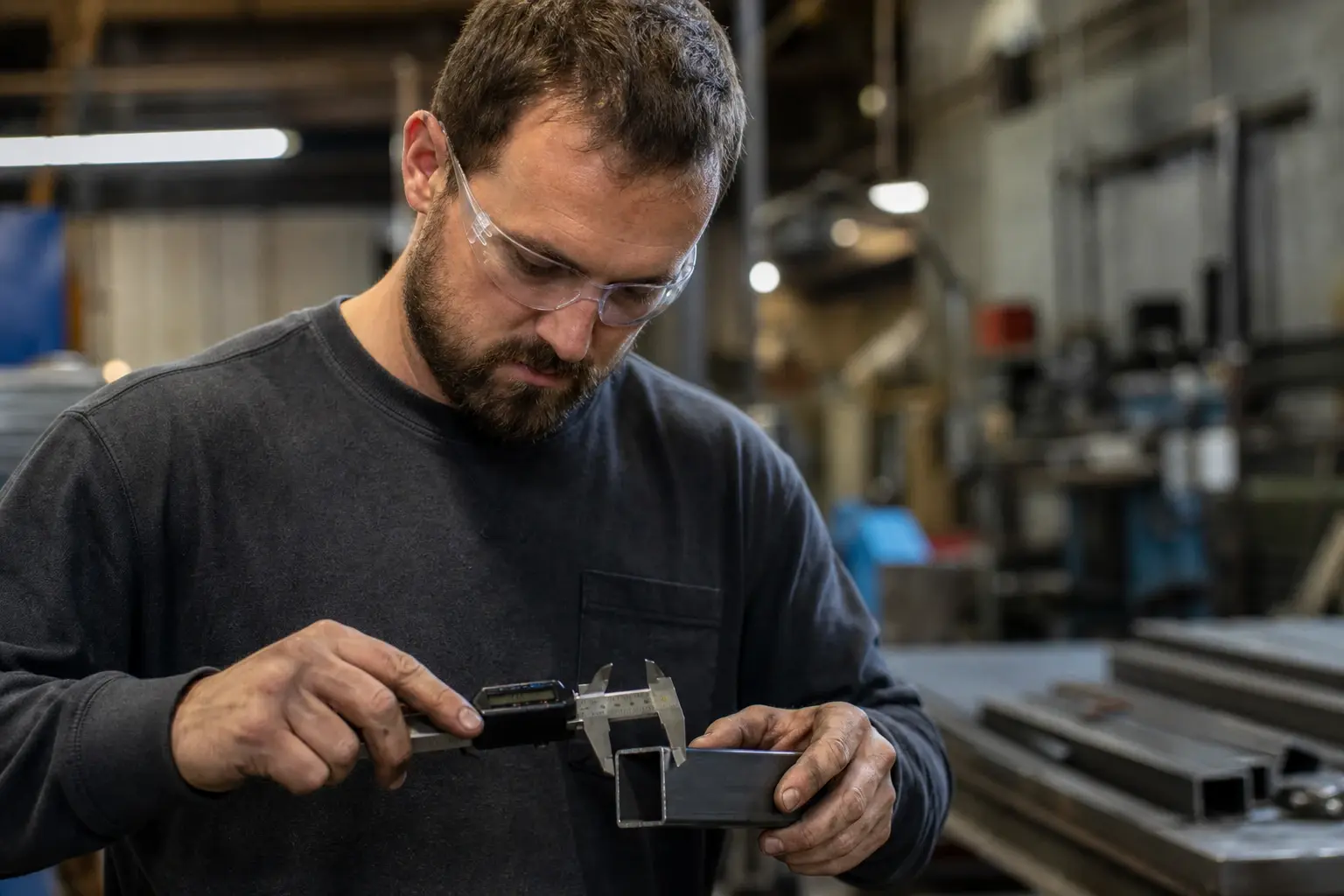
The precision advantage is significant. Because the tube never leaves the machine between operations, every feature is referenced from the same datum. Positional accuracy of ±0.003 inches is achievable and repeatable across production runs of hundreds or thousands of identical parts. For data center cooling manifolds where branch connections must align precisely with rack-mounted heat exchangers, this level of consistency eliminates the field modifications that plague conventionally fabricated components.
The Lead Time Mathematics
The lead time reduction from single-process cutting is not a vague marketing claim. It follows directly from eliminating the non-productive time embedded in multi-step fabrication.
Consider a representative data center cooling project requiring 1,500 unique stainless steel tube components across 85 distinct part numbers. Under conventional fabrication, the workflow looks something like this:
Material procurement and receiving takes 2 to 3 weeks for stainless steel tube stock. Saw cutting and first-operation processing takes 2 to 3 weeks with queue time between batches. Secondary operations (drilling, slotting, notching, tapping) run concurrently but still require 2 to 3 weeks because parts must route between machines. Quality inspection between operations adds 3 to 5 days. Final packaging, labeling, and shipping preparation adds another week. Total elapsed time: 8 to 12 weeks from material receipt to delivery.
With tube laser processing, the same project compresses dramatically. Material procurement remains 2 to 3 weeks (this is a supply chain constraint, not a fabrication one). CNC programming can begin while material is in transit, using the 3D models directly. Once material arrives, single-process cutting replaces the entire secondary operations timeline. The 2 to 3 weeks of drilling, slotting, and notching compress into 1 to 2 weeks of continuous laser processing. Quality inspection is simplified because dimensional accuracy is inherent to the CNC process rather than dependent on operator skill. Every part leaves the machine with etched part numbers and assembly identifiers, eliminating manual labeling. Total elapsed time: 3 to 5 weeks from material receipt to delivery.
The time savings come from three sources: elimination of queue time between operations (the largest contributor), elimination of setup time for secondary fixtures, and reduction in quality hold points because the automated process produces consistent results.
For facilities like Blueline Industries, which processes high volumes of stainless steel tube components for data center and infrastructure projects, the ability to run machines for extended shifts further compresses timelines. A tube laser does not lose accuracy at hour 16 the way a fatigued manual operator might.
What This Means for Data Center Construction Schedules
The 4 to 7 weeks recovered through single-process fabrication carry outsized value in data center construction. These projects operate on aggressive timelines where every major system interconnects with others.
Mechanical contractors can begin installing cooling distribution systems weeks earlier, which means the plumbing and piping rough-in phase overlaps more efficiently with electrical work. Commissioning teams get access to the facility sooner, allowing extended testing periods that reduce the risk of day-one failures. And the data center operator begins generating revenue from the facility earlier, which at the scale of hyperscale deployments can represent millions of dollars per week in cloud computing capacity.
There is also a risk reduction benefit that is harder to quantify but equally important. When fabrication timelines are compressed through process efficiency rather than through shortcuts, the quality of delivered components actually improves. Parts fabricated in a single process have fewer opportunities for human error. Dimensions are more consistent. Assembly in the field goes faster because components fit as designed.
This contrasts with the common alternative response to schedule pressure: paying overtime premiums to rush multi-step fabrication. Overtime in conventional metal shops introduces fatigue-related errors, which then require rework, which consumes more time, creating a cycle that schedule pressure alone cannot break.
Material Considerations for Data Center Stainless Steel Tube Cutting
Not all stainless steel tube cutting is equal, and data center applications present specific material challenges that fabricators must understand.
The 304 and 316L grades most common in cooling infrastructure have higher thermal conductivity than carbon steel but lower than aluminum, which affects the heat-affected zone during laser cutting. A well-tuned fiber laser process produces a narrow kerf with minimal heat input, preserving the corrosion resistance of the parent material in the cut zone. This matters enormously for components that will carry coolant fluids for 15 to 20 years.
Wall thickness is another consideration. Data center cooling tubes typically range from 0.065 inches to 0.250 inches, with the thinner gauges used in distribution piping and heavier gauges in structural applications. Tube laser systems handle this range efficiently, adjusting power, speed, and assist gas pressure automatically through the CNC program. The same machine that cuts thin-wall 304L cooling tubes in the morning can process heavy-wall 316 structural members in the afternoon without manual recalibration.
Surface finish also matters in data center applications. Components visible in customer tours or located in clean environments need cut edges free of heavy dross or discoloration. The fiber laser cutting process, particularly when optimized with nitrogen assist gas, produces clean edges on stainless steel that require minimal or no post-processing. This eliminates the deburring step that adds time and cost to conventionally fabricated parts.
Selecting a Fabrication Partner for Data Center Stainless Steel Work
Data center construction managers evaluating stainless steel tube fabrication partners should look beyond basic price-per-piece comparisons. The total cost of fabrication includes several factors that traditional quoting methods obscure.
Dimensional consistency determines field installation speed. A fabricator delivering parts with ±0.003 inch accuracy means mechanical contractors spend less time on fit-up, shimming, and field modification. On a large data center project, consistent fabrication quality can save hundreds of labor hours during installation.
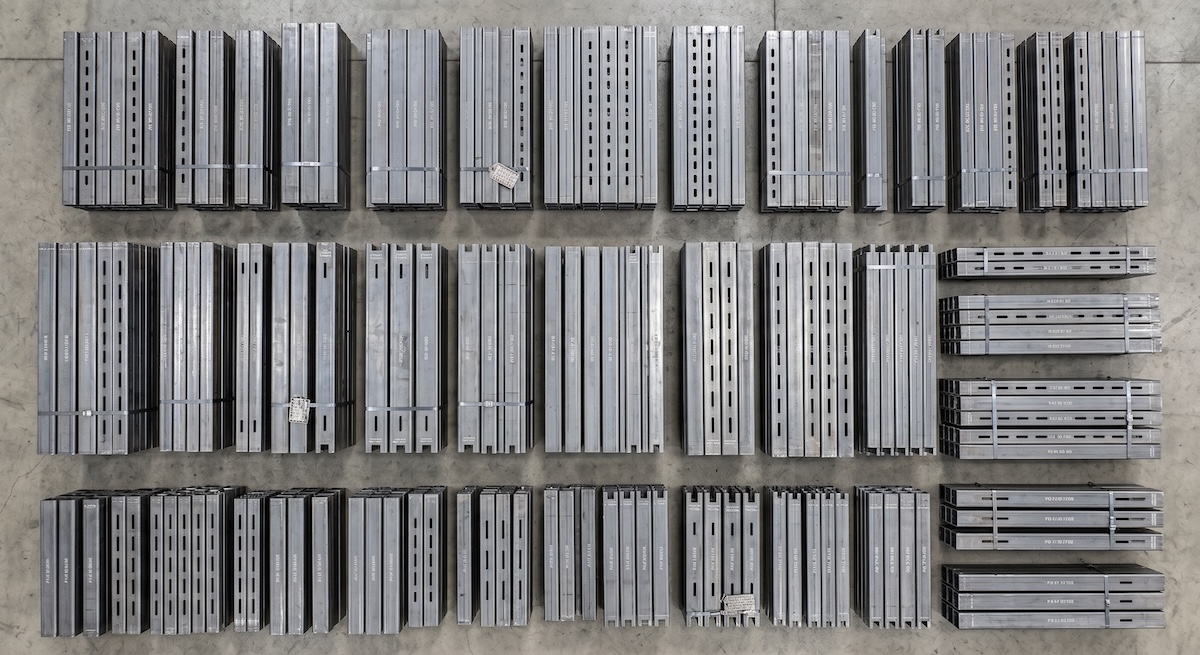
Part identification and packaging practices affect installation efficiency. Fabricators who etch part numbers directly onto components and bundle parts by assembly sequence (rather than by manufacturing batch) allow field crews to work systematically through installations without sorting through unmarked inventory. Blueline Industries, for example, bundles and labels every component per part number with etched identifiers matching assembly drawings, a practice that eliminates the confusion common on large-scale projects with thousands of similar-looking tube components.
Capacity and schedule reliability matter more than theoretical lead times. A fabricator with two tube laser machines and experienced programmers can maintain throughput even when one machine is down for maintenance. Ask about actual machine utilization rates and backup plans rather than best-case estimates.
Engineering support capability separates order-takers from true fabrication partners. Data center projects often arrive as architectural or schematic drawings that require translation into shop drawings with manufacturing-specific details. A fabricator with in-house engineering can identify design optimizations, such as converting welded assemblies into folded single-piece components, that reduce both fabrication time and field labor.
The Broader Shift in Data Center Fabrication
The adoption of single-process tube laser cutting for data center work reflects a broader transformation in how precision metal components get manufactured in the United States.
The reshoring trend, accelerated by supply chain disruptions and concerns about lead times from overseas fabricators, is pushing more data center component work to domestic shops. Facilities with advanced tube laser capability are capturing work that would previously have been sourced from multiple specialty shops or even imported.
The labor market reality is also driving adoption. The skilled welder and machinist shortage documented across the fabrication industry is particularly acute in high-cost regions like Southern California, where data center construction activity is intense. Tube laser technology does not eliminate skilled workers, but it changes the skill profile required. Programming and machine operation replace manual drilling and fitting, and one operator can maintain output that would previously have required three or four conventional machinists.
Environmental and sustainability considerations are increasingly entering procurement decisions for data center operators who have made public carbon commitments. Single-process tube laser fabrication produces less scrap material (typically 5 to 8 percent versus 12 to 15 percent for conventional multi-step processing), uses less energy per finished part, and eliminates the cutting fluids required for conventional drilling and tapping operations.
Frequently Asked Questions
What types of stainless steel are best for data center cooling infrastructure?
The 300-series austenitic grades dominate data center cooling applications. 304L is the standard choice for general cooling distribution piping because it offers excellent corrosion resistance at a reasonable cost. 316L is specified when coolant fluids contain chlorides or when components are located in environments with higher humidity, because its molybdenum content provides superior resistance to pitting and crevice corrosion. For structural tube framing within data centers, 304 is typically adequate. The "L" designation (low carbon) is important for any components that will be welded, as it reduces susceptibility to intergranular corrosion in the heat-affected zone.
How does tube laser cutting maintain precision across thousands of identical parts?
CNC-controlled tube laser systems reference all features from a single datum established when the tube is loaded into the machine's chuck system. Because the tube remains fixtured throughout the entire cutting sequence, there is no cumulative positional error from re-clamping between operations. The machine's encoder systems track position with resolution far finer than the ±0.003 inch tolerance required for most data center components. Temperature compensation algorithms account for thermal expansion during extended production runs. The result is that part number 1,500 comes out dimensionally identical to part number 1.
Can tube laser cutting replace welded assemblies in data center applications?
In many cases, yes. One of the most valuable design optimizations that tube laser technology enables is the "cut and fold" technique, where three sides of a tube are laser-cut so the material can be folded to create a precise 90-degree joint without welding. This is particularly useful for structural frames and mounting brackets where weld quality inspection adds time and cost. It also eliminates the heat distortion that welding introduces, which is important for maintaining tight dimensional tolerances on long assemblies. That said, some connections still require welding, particularly structural joints carrying significant loads. The goal is to minimize welding rather than eliminate it entirely, reducing both fabrication time and the dependency on scarce skilled welders.
What project size makes single-process tube laser cutting cost-effective for data centers?
The economics favor tube laser cutting across a surprisingly broad range of project sizes. For large hyperscale projects involving thousands of components, the lead time and labor savings make the value proposition overwhelming. But even mid-scale projects (200 to 500 components) benefit because the CNC programming cost is amortized across all parts and setup time is minimal. The breakeven point compared to conventional fabrication typically occurs around 50 to 100 components for projects with moderate geometric complexity. Single custom pieces may still be cheaper to produce conventionally, but any project requiring multiple features per part (holes, slots, notches, cutouts) will see cost and time advantages from tube laser processing.
How should data center project managers evaluate stainless steel fabrication bids?
Look beyond the unit price. Request information on dimensional accuracy guarantees (what tolerances will the fabricator hold, and how do they verify compliance?). Ask about part identification practices, specifically whether part numbers will be etched directly onto components or only applied via stickers that fall off during installation. Evaluate packaging and delivery logistics: will parts arrive bundled by assembly sequence or by manufacturing batch? Inquire about engineering support for drawing review and design optimization. Check references from other data center projects, not just general fabrication work. And critically, ask about machine capacity and backup plans. A fabricator running a single tube laser at 95 percent utilization has no margin for machine downtime, which means your schedule has no buffer.
Blueline Industries operates advanced tube laser systems from its Riverside, California facility, serving data center, infrastructure, and manufacturing clients across Southern California and beyond. For stainless steel fabrication quotes on data center projects, visit bluelineind.com or call (951) 833-5597.


.png)