Quick Summary
Precision tube cutting tolerances work best when the drawing says which features must be tight and which can float. At Blueline Industries in Chino, CA, our tube laser cutting starts from your print, so a clear callout saves a round of questions. Blueline states tolerances of plus or minus 0.003 inch, but that number only helps when the drawing shows where it applies.
We already cover what a tube laser can hold in What Tolerances Can Tube Laser Cutting Hold?. This post is about the other half: how to write the callouts so the part you drew is the part you get.
What does precision mean for a cut tube part?
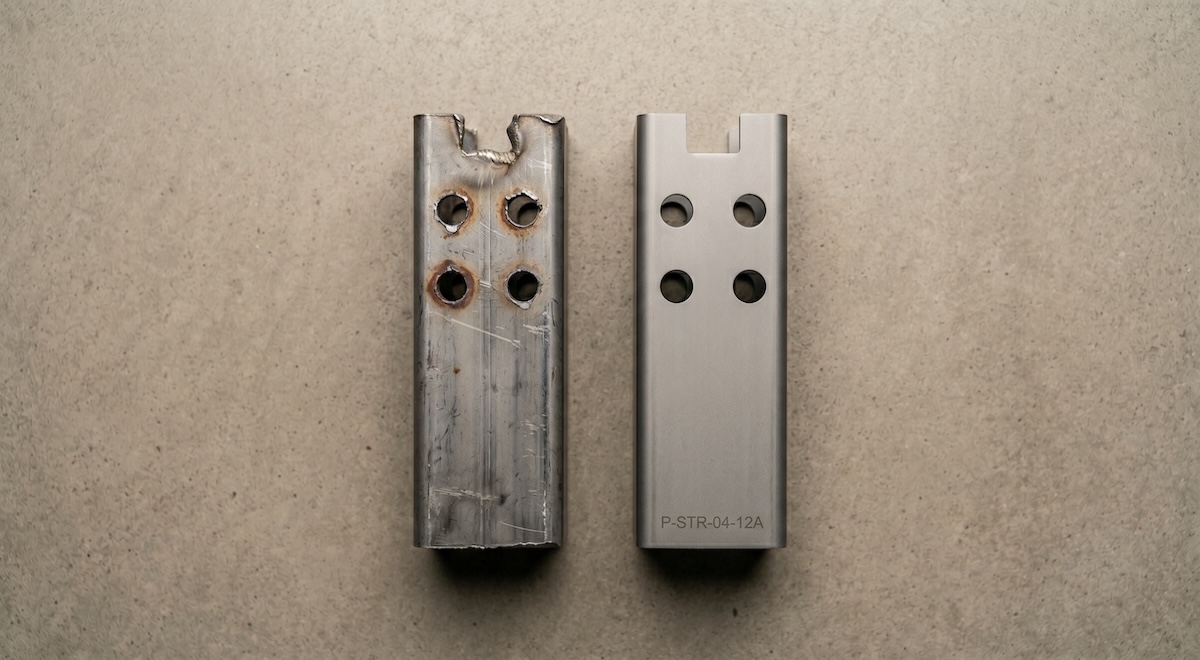
Precision means the cut features land where the drawing says, measured from the datums you named, on every part in the run. It is a result of the cut and the tube together. A laser can position a slot very accurately, but the tube it cuts has its own size and shape variation.
Many prints carry one tight number across every feature. That makes every feature look critical, and it hides the two or three that actually control fit. A better print tags the critical features and sets a general tolerance for the rest.
Our precision tube fabrication work follows the same logic. We aim our attention where your assembly needs it.
Which features deserve a tight tolerance?
Tighten the features that control fit or load path: slot and tab positions that locate mating parts, hole patterns that take pins or fasteners, and end cuts that set overall length. Leave relief holes, decorative cuts, and non-mating edges on the general tolerance. Each tight callout adds inspection effort.
Features that usually earn a tight callout
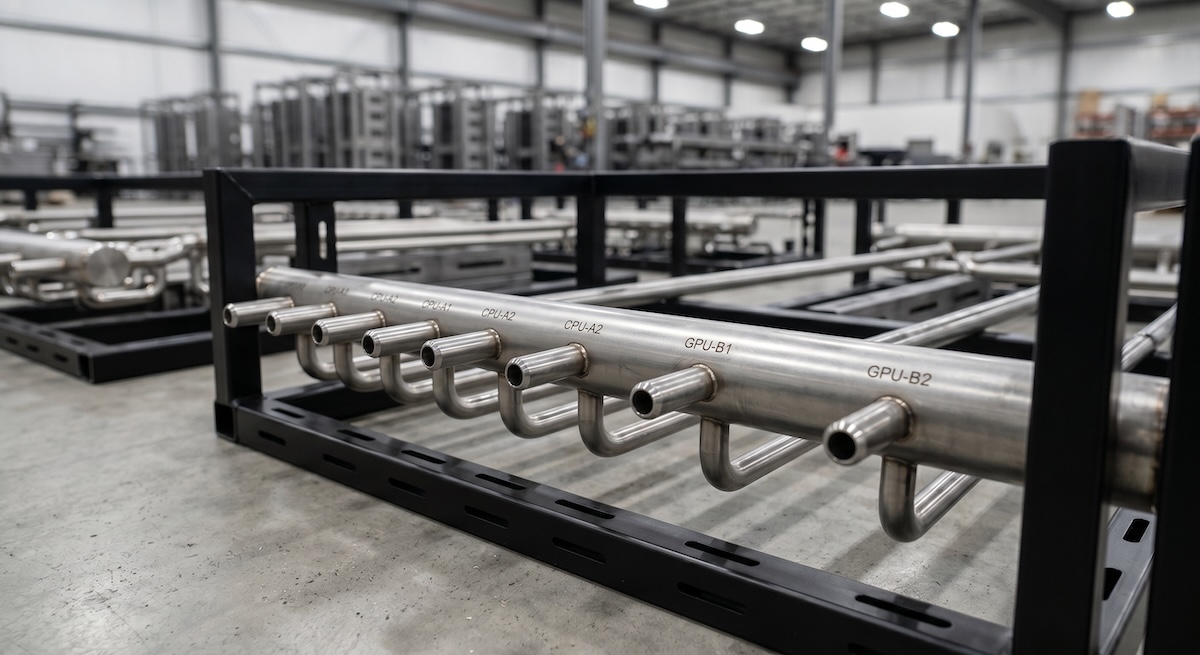
Slots that receive another tube. Hole pairs that must line up across a joint. Cut ends that butt against a plate or another member. If a feature decides whether two parts go together, mark it.
Features that can float
Lightening holes, cosmetic notches, and edges that nothing touches. These rarely change how the assembly fits, so a general tolerance is usually enough.
Slot fit also depends on kerf, the width of material the laser removes. Our post on kerf and slot fit shows how to plan for it.
A simple test for any callout
Ask one question about each tight tolerance: what breaks if this feature is off by a little? If the answer is "the joint will not close" or "the pin will not go through," keep the callout. If the answer is "nothing," relax it. This keeps your print readable and keeps inspection time on the features that matter.
It also helps when a design changes. A print with a few clear critical features is easier to revise than one where every dimension carries the same tight limit, and it is easier for a buyer to compare quotes against.
How does the tube itself change cut accuracy?
Tube is not a perfect blank. Its outside dimensions, wall thickness, corner radius, and straightness all vary within the mill's limits. The laser positions cuts relative to the tube, so stock variation shows up in the finished part. State the tube size, wall, and grade on the print so everyone starts from the same blank.
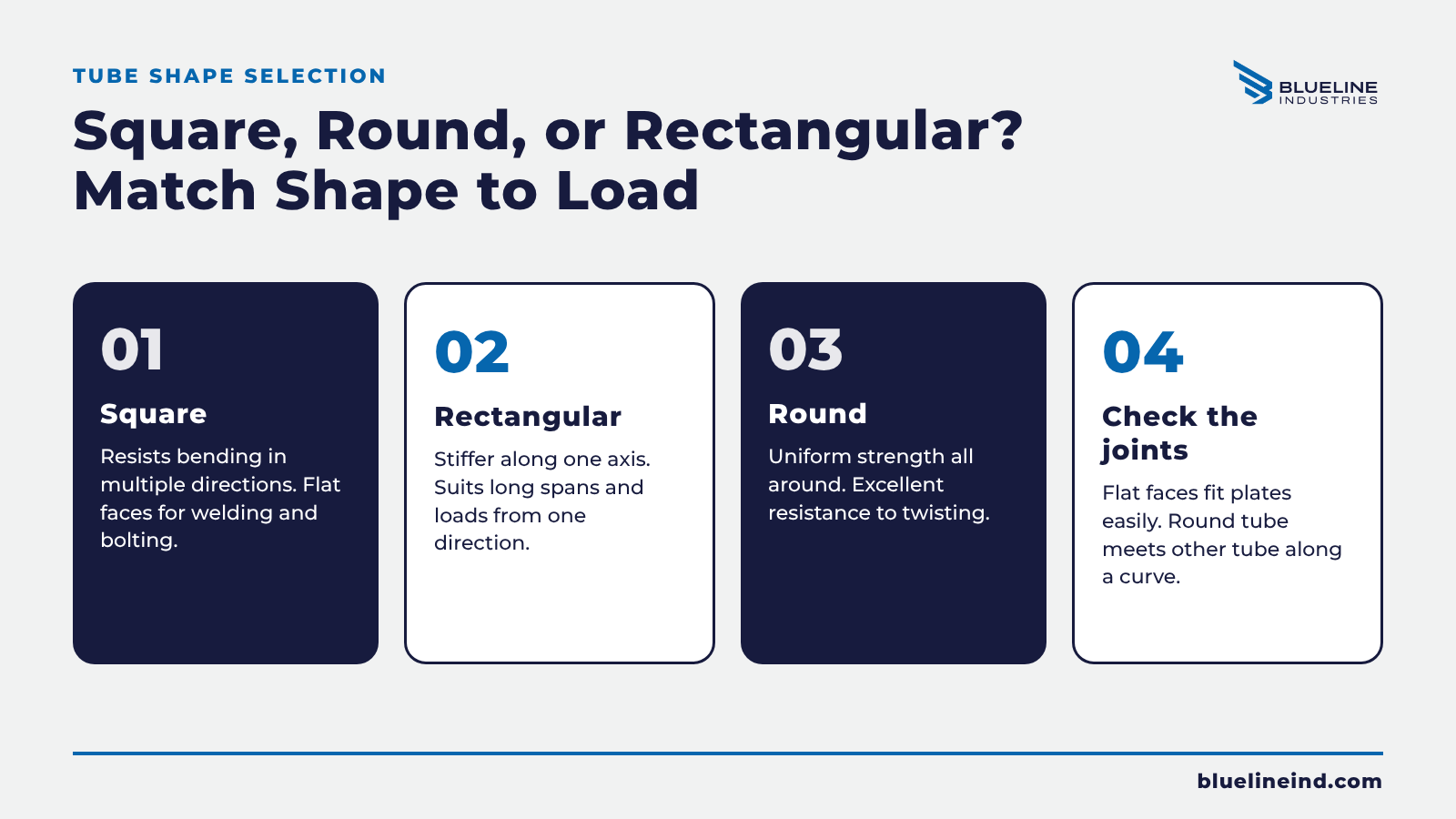
Shape matters too. A square tube with a generous corner radius presents a different edge than one with a tight radius, and our post on square tube corner radius covers what that changes.
Long, thin-walled tube can move during cutting, and dense cut patterns add heat. If your part has either, say so early. Our guides to thin wall tube and the heat affected zone explain why.
How should you write tolerances on a tube drawing?
Pick datums first, then dimension every critical feature from them. Use GD&T position or profile callouts where the relationship between features matters, and plus-minus limits for simple lengths. Add a general tolerance note for everything else. Mark datum faces on the tube so cutting and inspection reference the same surfaces.
GD&T stands for geometric dimensioning and tolerancing, the standard symbol language for describing how parts fit. The SAE J2551-1 bent-tube specification, as summarized by Advanced Tubular, recommends GD&T because it is globally recognized. The same summary advises against hard-point alignment, because it magnifies errors at the datums.
That specification covers bent tube, not laser cutting. The principle still carries over: choose datums deliberately and let the callouts do the work.
Callout options at a glance
CalloutWhat it controlsBest usePlus-minus lengthOverall length or a single distanceSimple cut lengths and end-to-end dimensionsPositionWhere a hole or slot sits from the datumsHole patterns and slots that locate mating partsProfileThe shape of a cut contourNotches and copes that must match another tubeGeneral tolerance noteEverything not called outNon-critical features
How do tolerances stack up across a tube assembly?
Each mating feature adds its own variation, so errors add up across the assembly. Three slots that each hold a small tolerance can still combine into a visible gap at the far end. Dimension every feature from one datum instead of chaining from feature to feature, so error does not build along the part.
Scale makes this matter more. Blueline processed 16 truckloads of stainless steel for an AI data center cooling project in Sacramento in 2025. At that volume, parts cut on different days still have to go together, and a print with clearly named datums gives everyone one shared reference.
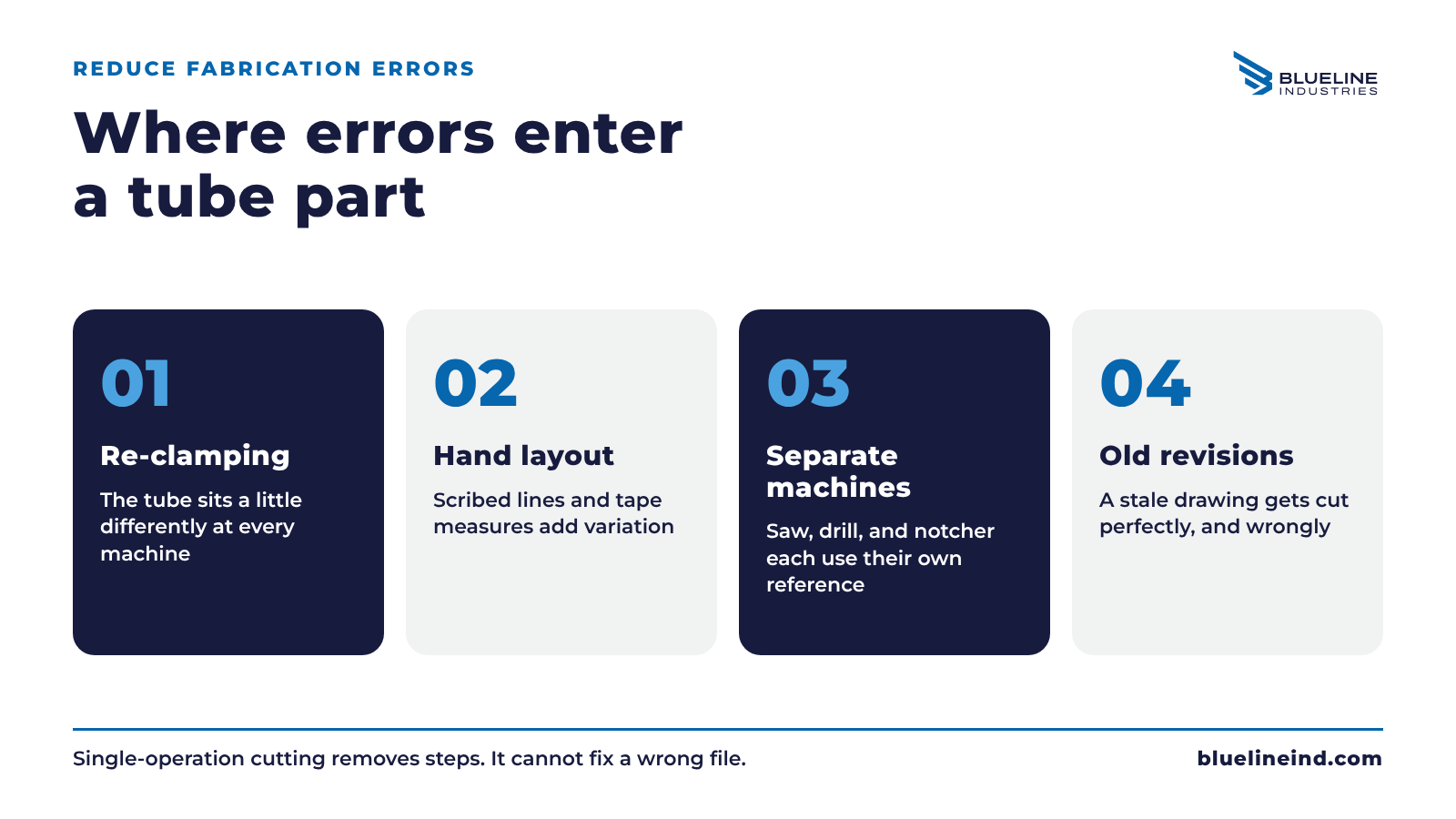
Single-operation processing also helps. According to Blueline, single-operation processing can reduce error rates by up to 70%. Fewer re-clamps means fewer places for position to drift. See our tube laser cutting for manufacturing OEMs page for how that works.
FAQ
Does a tighter tolerance always cost more?
Often, yes. Tighter callouts add inspection and can limit how a part is run. Cost depends on the part and the shop, so send a quote request with the critical features marked.
What tolerance does Blueline state?
Blueline states tolerances of plus or minus 0.003 inch. Whether that applies to your feature depends on the part, the tube, and the setup, so confirm it with us at quote.
Should I use GD&T or plus-minus tolerances?
Use plus-minus for simple lengths and GD&T for feature relationships such as hole patterns and slot positions. Many prints use both. Pick whichever states your intent more clearly.
Do I need to state the tube grade and size?
Yes. Tube size, wall thickness, and material grade set the starting point for every cut. Put them on the print so the shop and your inspector work from the same blank.
What should I send with a quote request?
Send your CAD file and a print with datums and critical features marked. Include tube size, wall, material, and quantity. Our CAD file checklist lists the rest.
A clear print is the fastest path to a part that fits. Made in America, built on integrity: that is how we approach every job at our Chino, CA shop.
Ready to talk through your print? Get a Quote or call (951) 833-5597.