Quick Summary
- ERW tube is formed from coiled strip and welded. DOM tube starts as ERW and is cold drawn over a mandrel. Seamless tube is made from a solid billet with no seam.
- The type changes consistency, surface, and cost, so decide it before you send a cut list.
- Tolerance numbers vary by source. Ask your tube supplier for the actual spec.
- Tell your tube laser shop the tube type, size, wall, and grade in the first request.

ERW vs DOM tube is a material choice that shapes how parts fit after cutting. ERW is the economical welded tube, DOM is welded tube that has been cold drawn for tighter control, and seamless tube has no weld seam at all. Blueline Industries is a tube laser cutting and precision metal fabrication shop in Chino, CA, and the tube you pick is the first thing we ask about.
This post explains the three types in plain terms, using what published tube guides say. It is not a spec. Your tube supplier's certs and your engineer's drawing always win.
What is the difference between ERW, DOM, and seamless tube?
ERW tube is made by forming coiled steel strip into a round and welding the seam with electrical resistance. DOM tube starts as ERW tube, then is cold drawn over a mandrel. Seamless tube is pierced or extruded from a solid billet, so it has no weld seam.
The sources agree on the basics. One tube supplier says DOM “starts as ERW tube but is then cold-drawn over a mandrel to remove weld flash and refine wall thickness.” Another guide says seamless tubes “are manufactured without any welding.”
Side-by-side summary
TypeHow it is madeWeld seamRelative costERWCoiled strip formed and resistance weldedYes, and an internal bead may remainUsually the lowestDOMERW tube cold drawn over a mandrelPresent but refined, often hard to seeHigher than ERWSeamlessPierced or extruded from a solid billetNoneUsually the highest
Cost order comes from the published guides we read. Actual prices depend on the supplier and the market, and Blueline does not quote tube prices in blog posts.
How do tolerances compare between ERW and DOM tube?
DOM generally holds tighter size and wall control than ERW, because the cold drawing step refines the tube. Published figures differ by source and size, so use them only as a rough guide and request the supplier's actual tolerance for the tube you are buying.
Here is what two guides say. Treat these as examples, not specs.
- One tube supplier lists DOM outside and inside diameter tolerances “as tight as ±0.005″ on smaller sizes.” It lists ERW at “typical OD tolerances of ±0.015″ to ±0.030″” and cold-drawn seamless at “around ±0.010″ to ±0.020″.”
- A different guide on tube bending lists wall tolerance at “±10%” for DOM and “±10% to ±15%” for ERW.
Notice that the two guides do not use the same measures. That is normal. It is also why you should never design to a blog number.
Why does tube type matter for a laser cut part?
Tube type matters because laser cut features depend on the tube being the size you drew. If the outside diameter or wall varies, slots, tabs, and mating parts can fit looser or tighter than planned. Weld seam and bead position can also affect how a part assembles.
A few practical points follow from the guides:
- ERW tube may keep an internal weld bead. One guide says “standard ERW tubing has an internal weld bead,” which matters if another tube or a pin slides inside.
- DOM is sold for jobs where dimensional precision counts, such as hydraulic cylinders and precision mechanical parts, according to the supplier guide above.
- Seamless tube has no seam to place, which removes one variable. One guide says it offers “the highest level of surface quality and dimensional accuracy.”
For how fit is called out on a drawing, see how to call out precision tube cutting tolerances.
When does each tube type make sense?
Match the tube to the job. Use ERW where cost matters and the fit is forgiving, DOM where size control matters, and seamless where you need no seam or the highest surface quality. The price rises in that order, so pay for precision only where the part needs it.
ERW
One guide calls ERW “cost-effective; sufficient for non-critical structural use.” Parts that get welded and adjusted can often tolerate more variation.
DOM
DOM suits parts where mating features need a more consistent tube. Examples include sliding fits and precision assemblies. The extra processing is why the guides list it at a higher cost.
Seamless
Seamless tube is the most expensive option in the guides we read. It makes sense when a seam would cause a problem, or when your engineer specifies it.
Whichever type you choose, the grade and wall thickness still matter. Our post on stainless versus carbon steel tube covers that side of the decision.
What should you tell your tube laser shop about the tube?
Tell your shop the tube type or spec, the outside dimensions, the wall thickness, and the material grade. Say whether you are supplying the tube or asking the shop about material. Note any feature that depends on the seam or the inside of the tube.
Put it in the first request, not the third email. A short checklist works well:
- Tube type or standard on your drawing, such as ERW, DOM, or seamless.
- Outside diameter or side dimensions and wall thickness.
- Material and grade.
- Any seam position requirement, and any feature inside the tube.
- Quantity, and whether this is a prototype or a repeat run.
Our guide to preparing CAD files for tube laser cutting covers the file side. For the services behind this, see steel tube laser cutting and precision tube fabrication.
Why do material questions get settled early on big jobs?
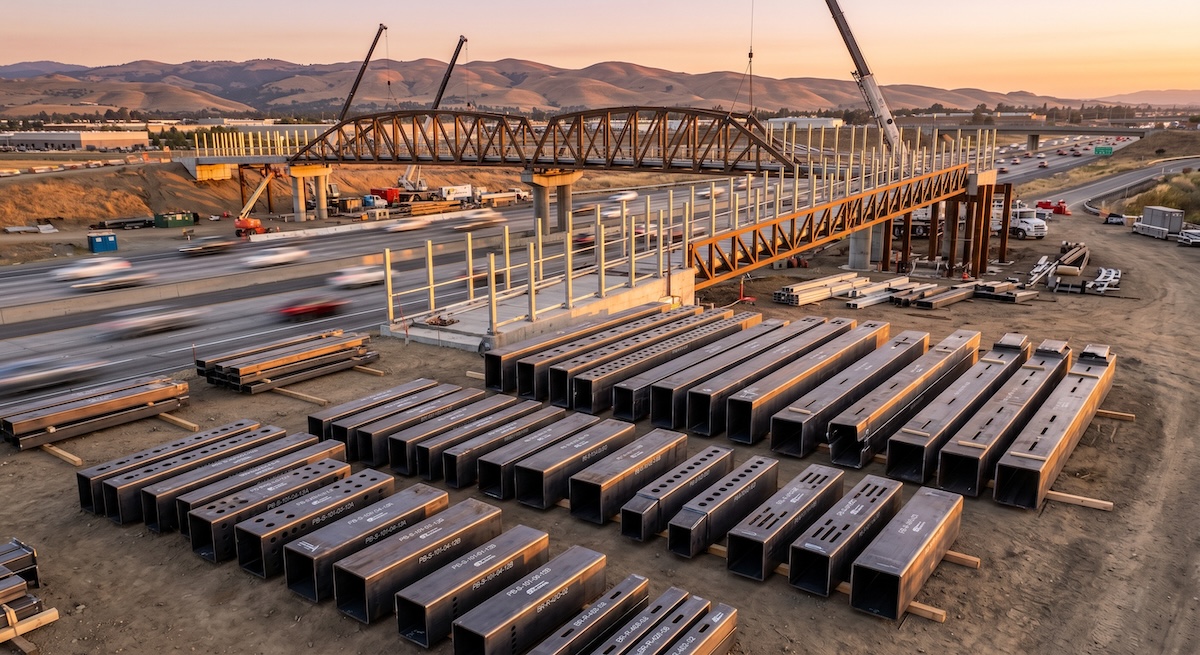
On large jobs, a late material change is costly because the steel is already moving. Blueline's work on the Caltrans I-5 pedestrian bridge in Irvine involved more than 500,000 pounds of steel in 2025. At that weight, the tube spec is a decision to lock before cutting starts.
We are not saying which tube type that project used. The lesson is general: settle the spec first, then cut.
Frequently asked questions
Is DOM tube just ERW tube with extra steps?
Yes, in a sense. Published guides describe DOM as ERW tube that is cold drawn over a mandrel. That extra step refines the tube, which is why DOM costs more.
Does seamless tube cost more than ERW?
The guides we read say so. They describe ERW as the most affordable and seamless as the most expensive. Real prices depend on your supplier, so ask for a quote on the exact tube.
Can I use ERW for a precision fit?
It depends on the fit. ERW is described as providing moderate precision, so a tight sliding fit may call for DOM or seamless. Ask your engineer, and share the fit requirement with your shop.
What tolerance does Blueline hold when cutting tube?
Blueline states tolerances of plus or minus 0.003 inch. Tube material variation is separate from cutting accuracy, so confirm both for your part at quote time.
Where is Blueline located?
Blueline's only facility is in Chino, CA 91710. We ship and serve customers across the West, including Portland, Tucson, San Francisco, San Diego, Seattle, Salt Lake City, Las Vegas, San Jose, and Los Angeles.
The right tube type is the one your part needs, not the most expensive one. Send us your drawing and tube spec, and we will talk through what we see before cutting.
Get a Quote: use our contact page or call (951) 833-5597.